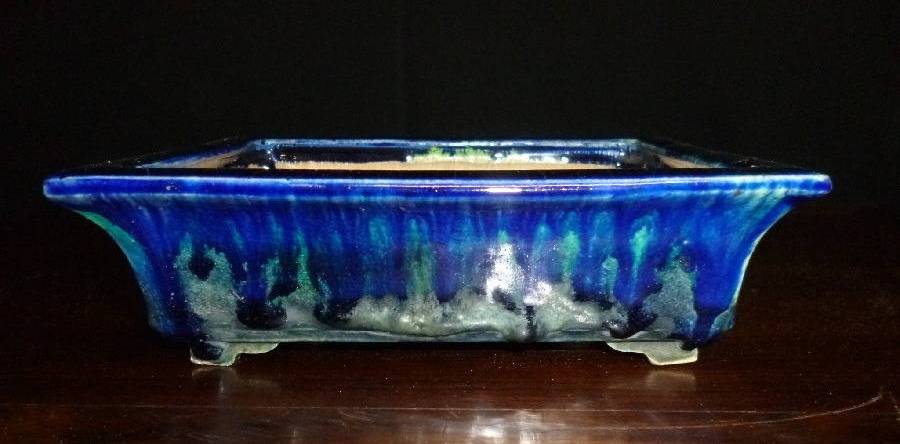
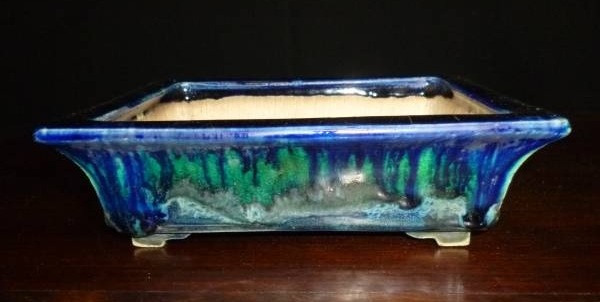
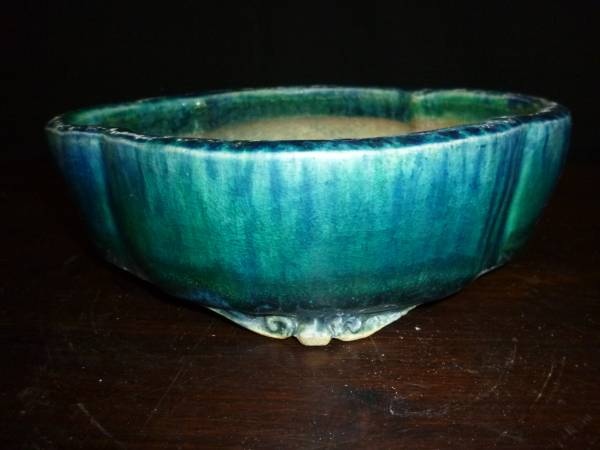
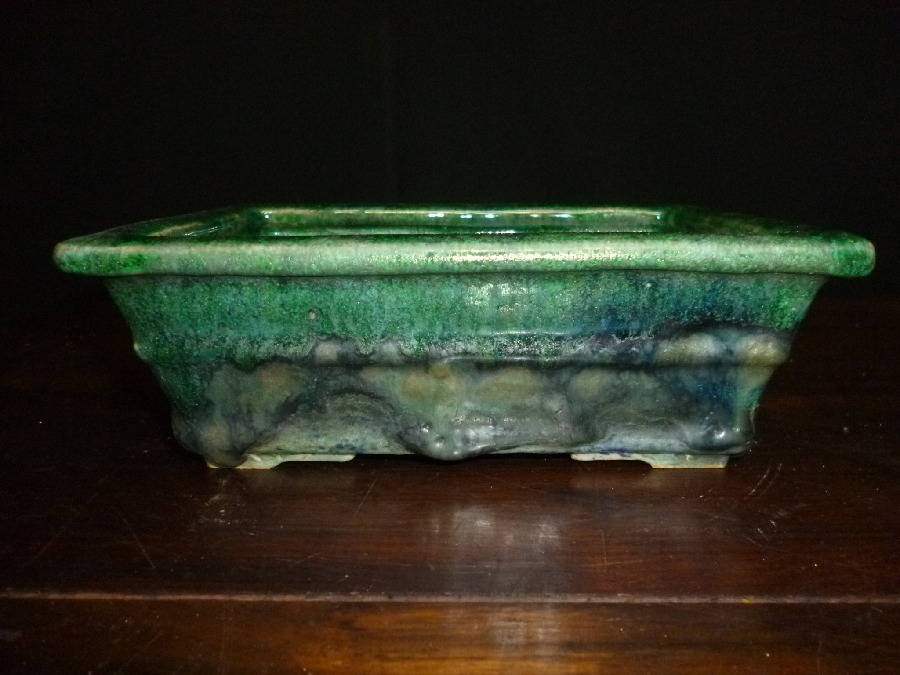
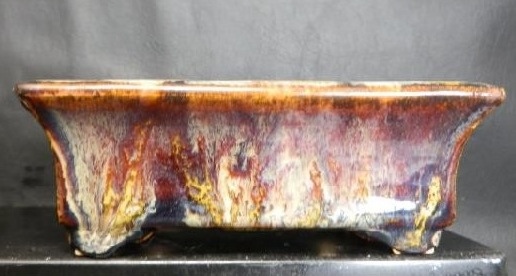
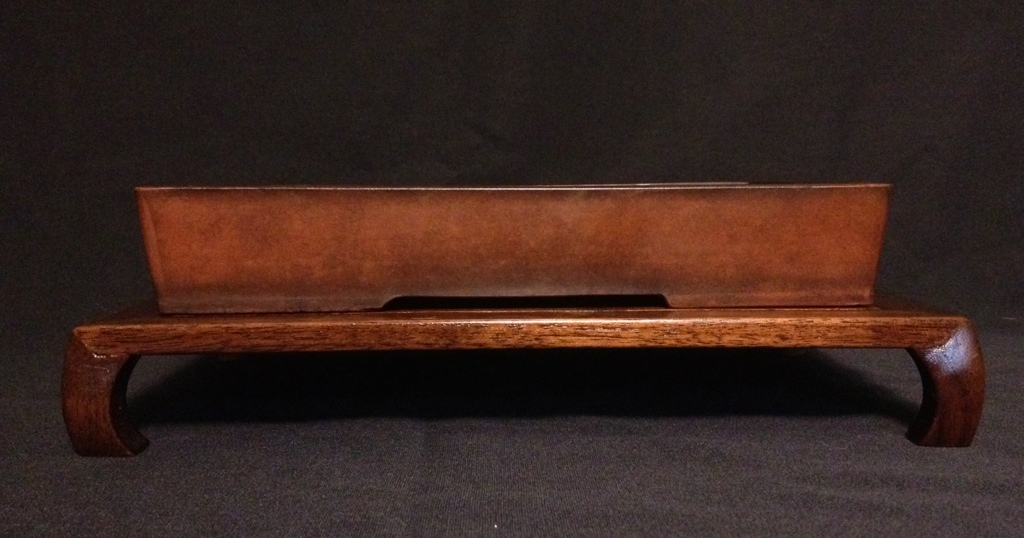
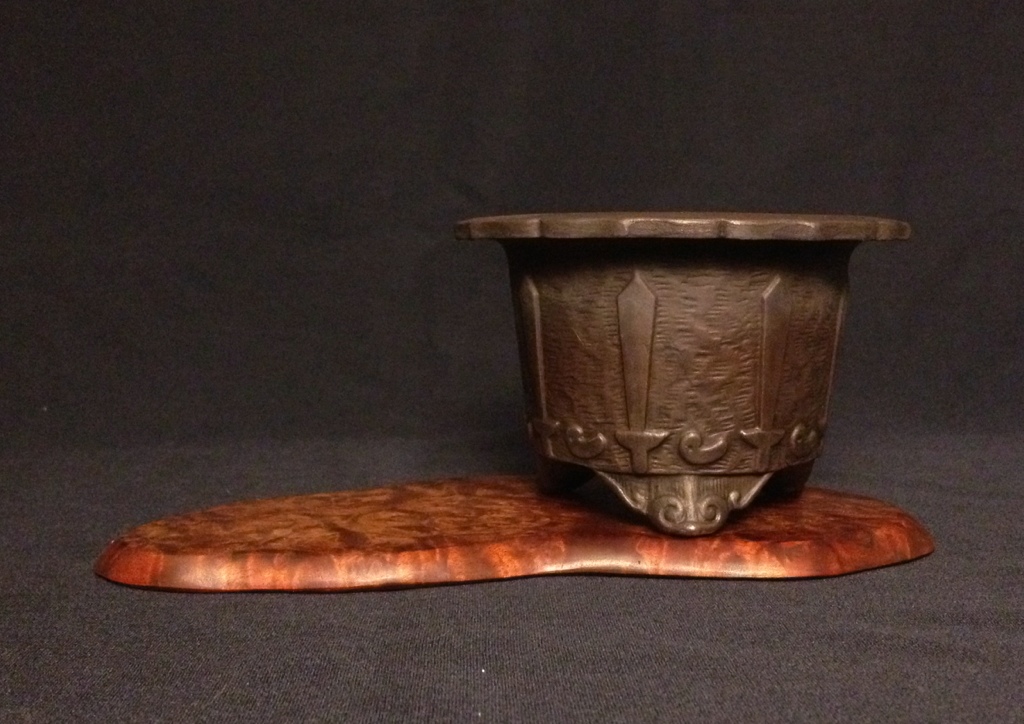
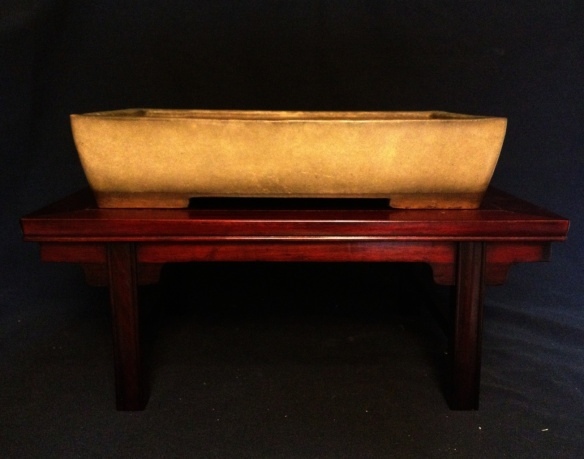
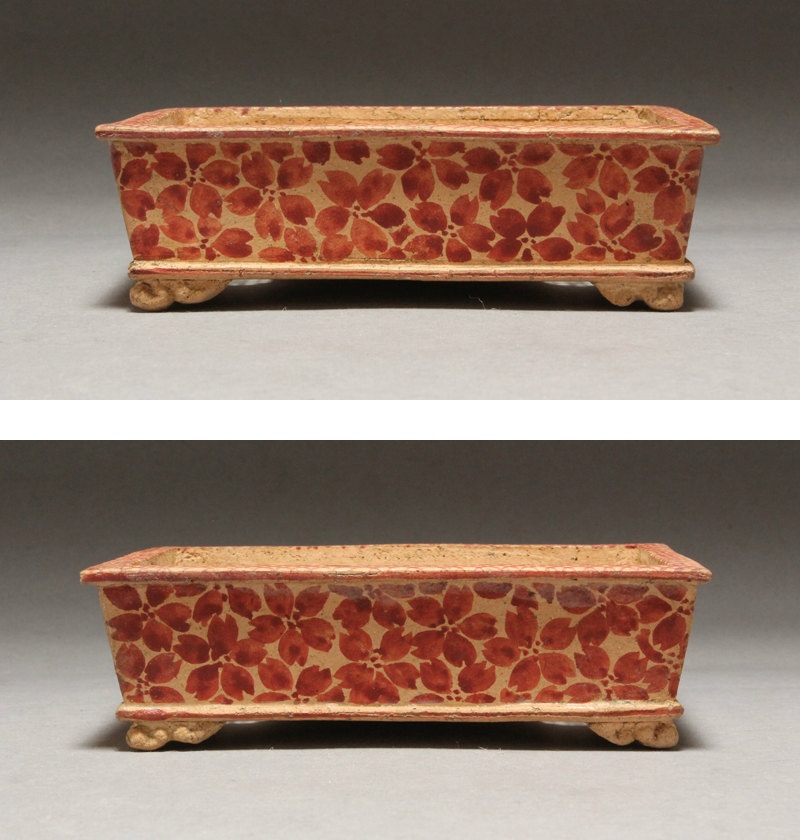
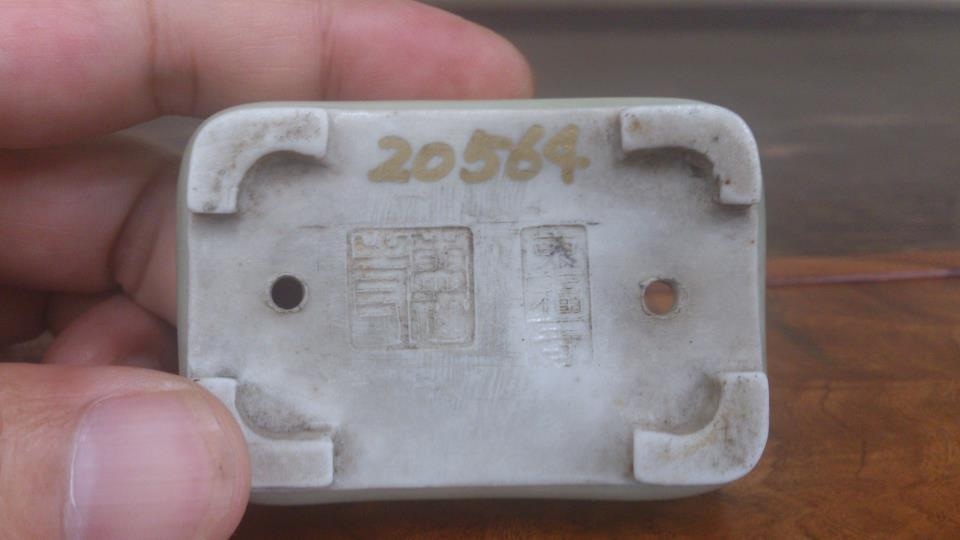
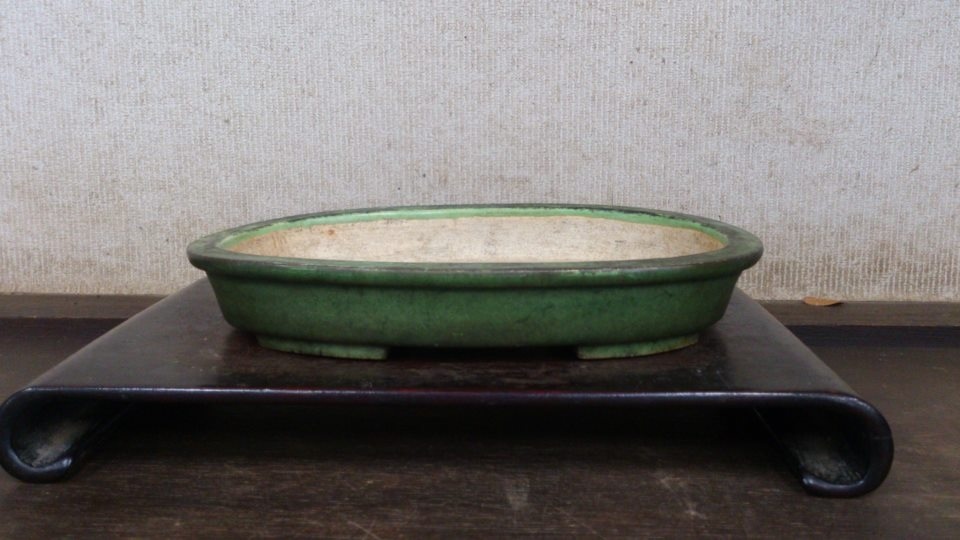
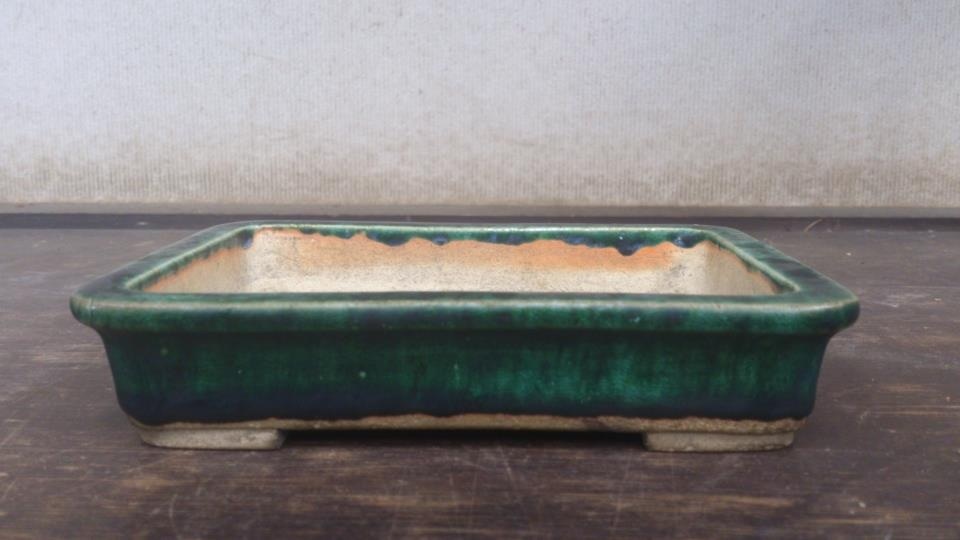
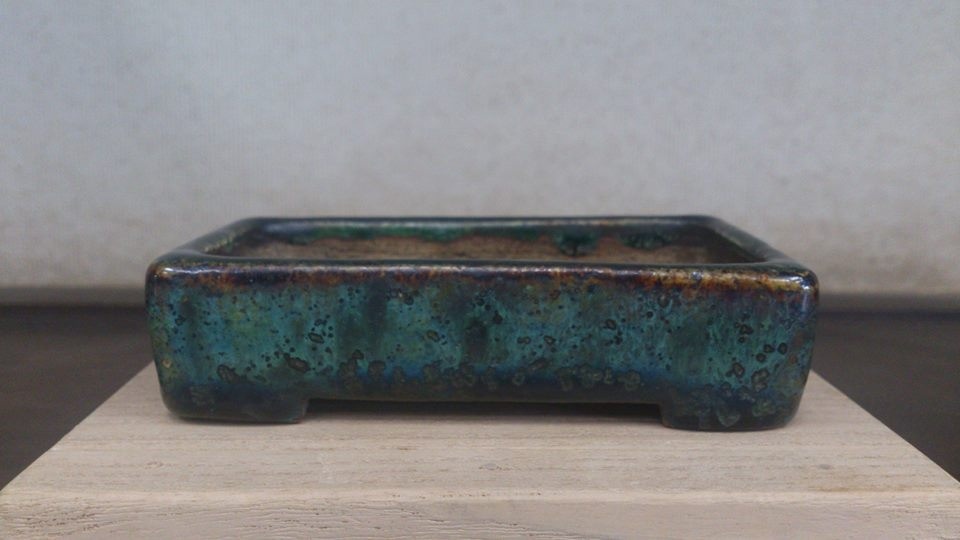
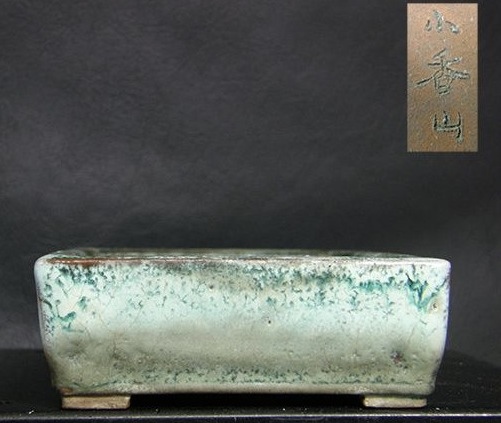
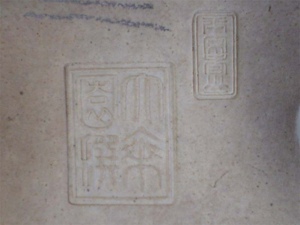
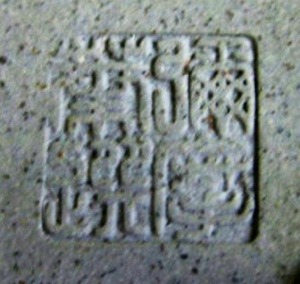
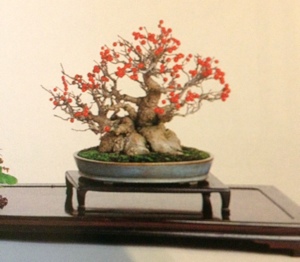
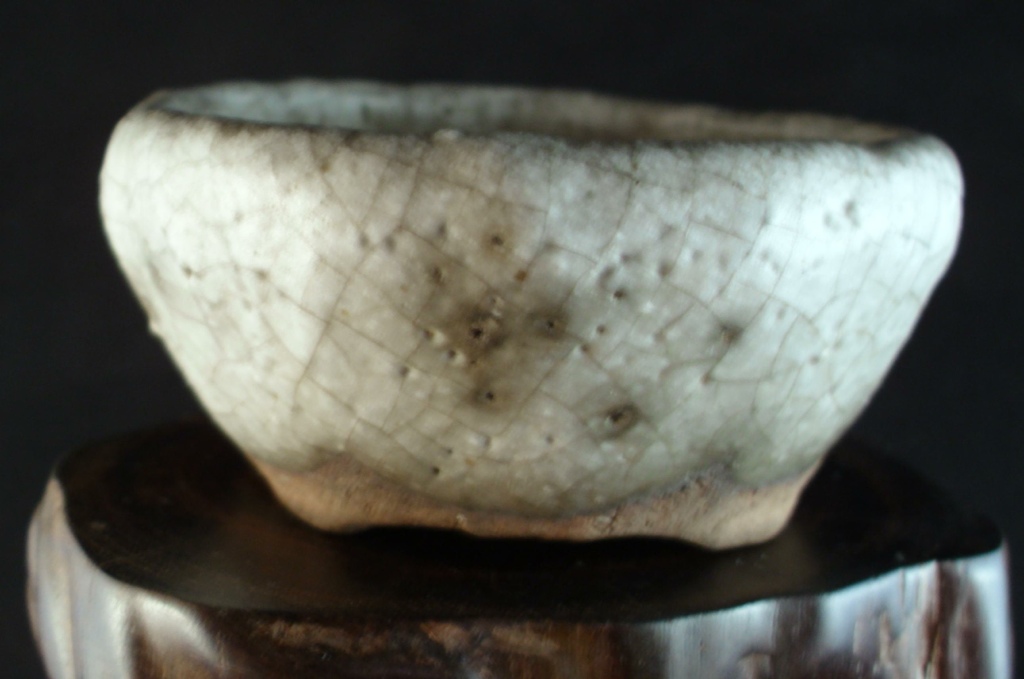
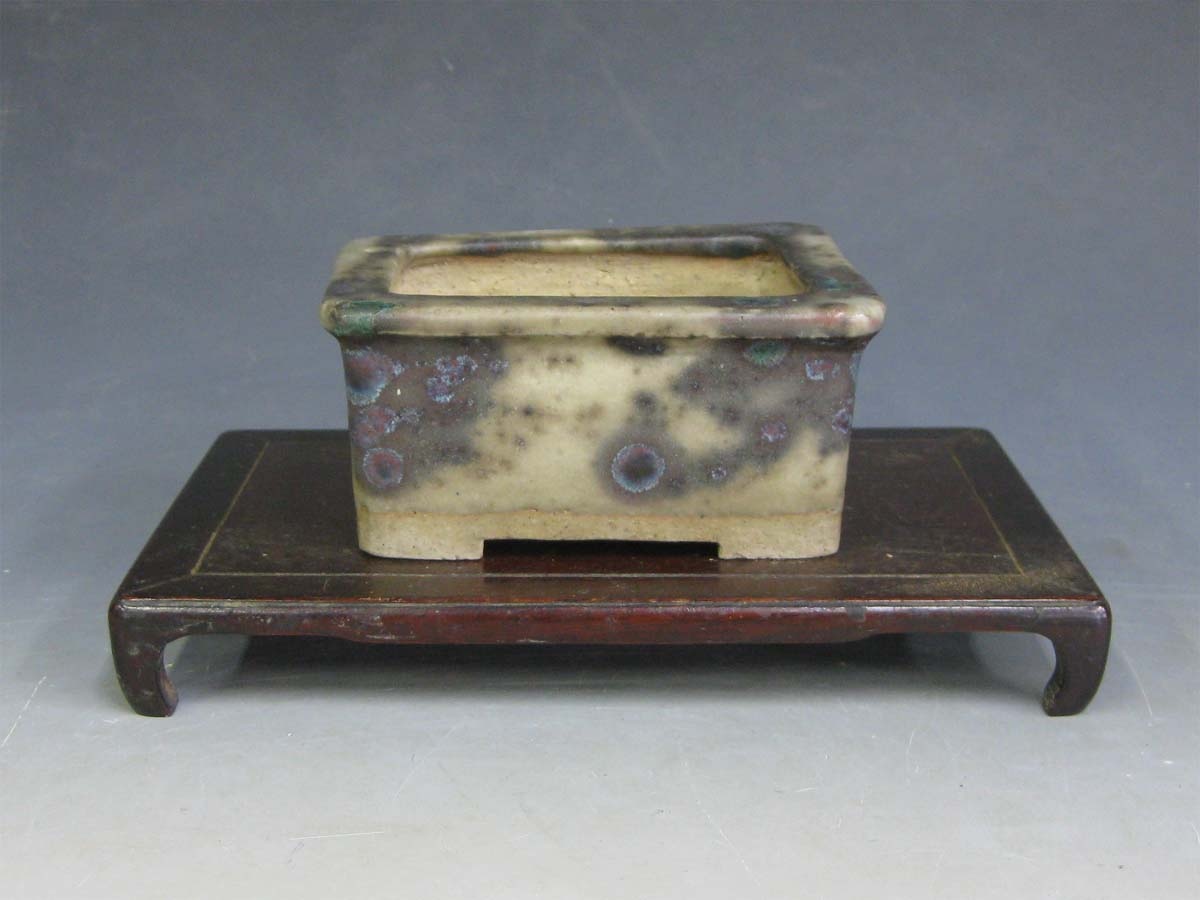
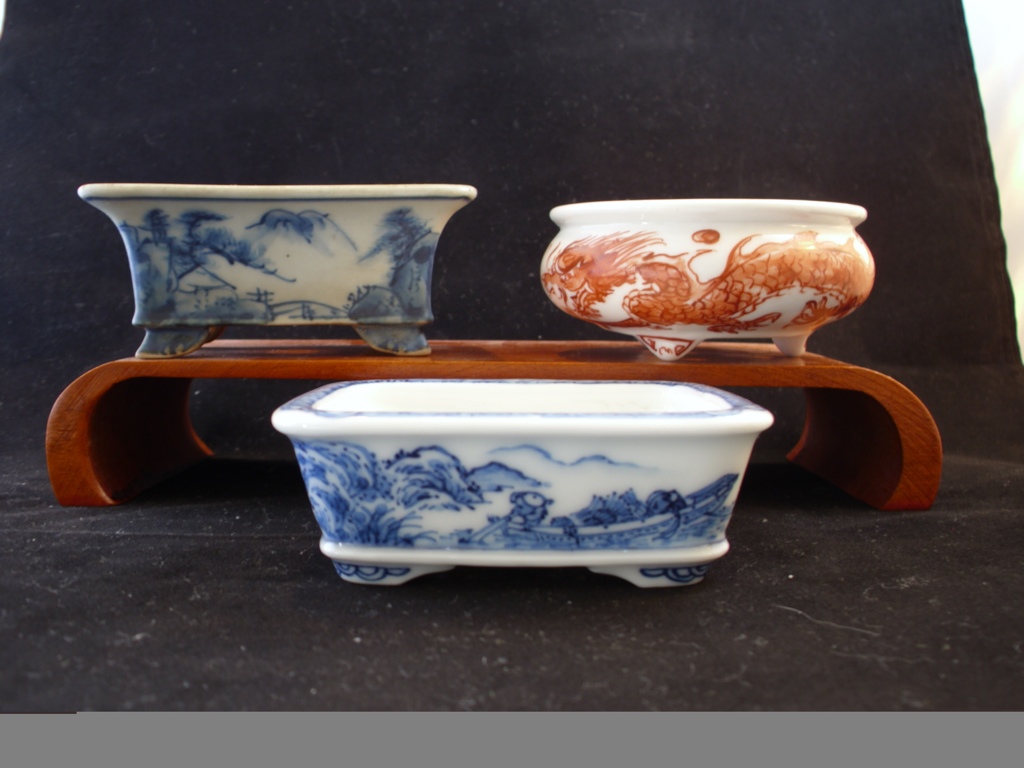
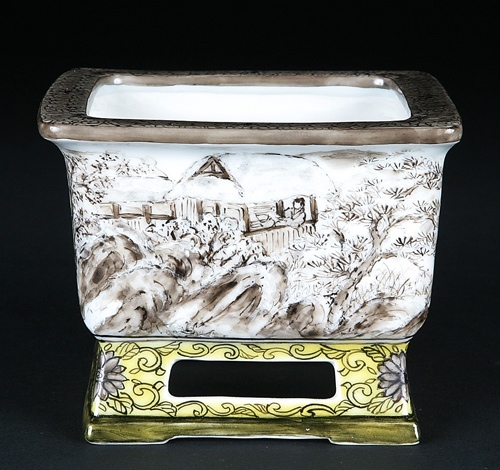
Pots From the Bushuan Kiln 4

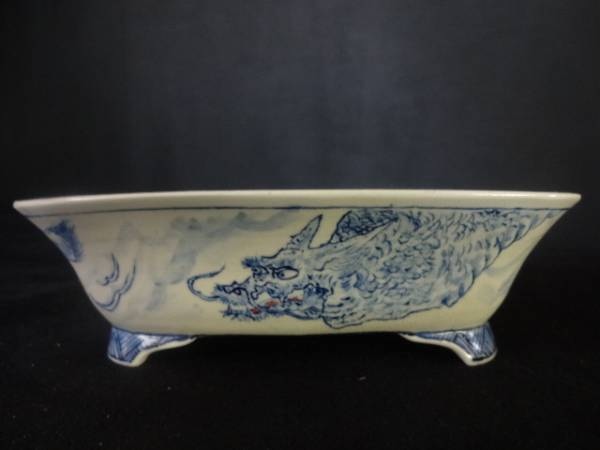
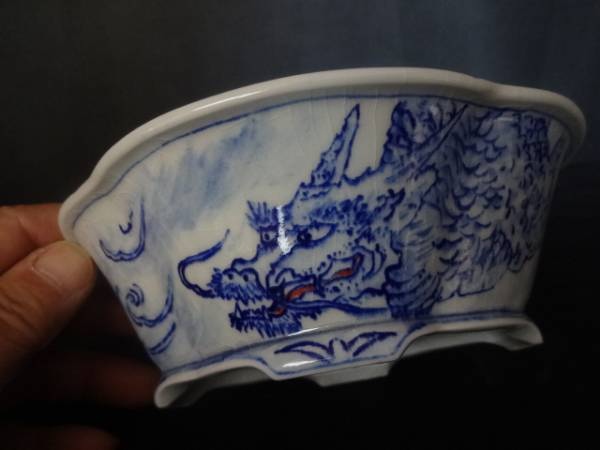
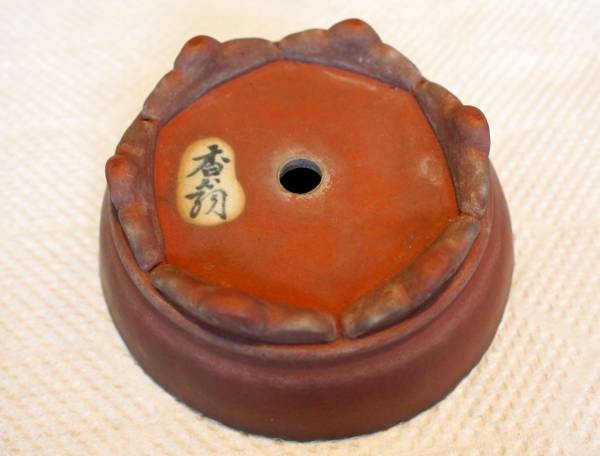
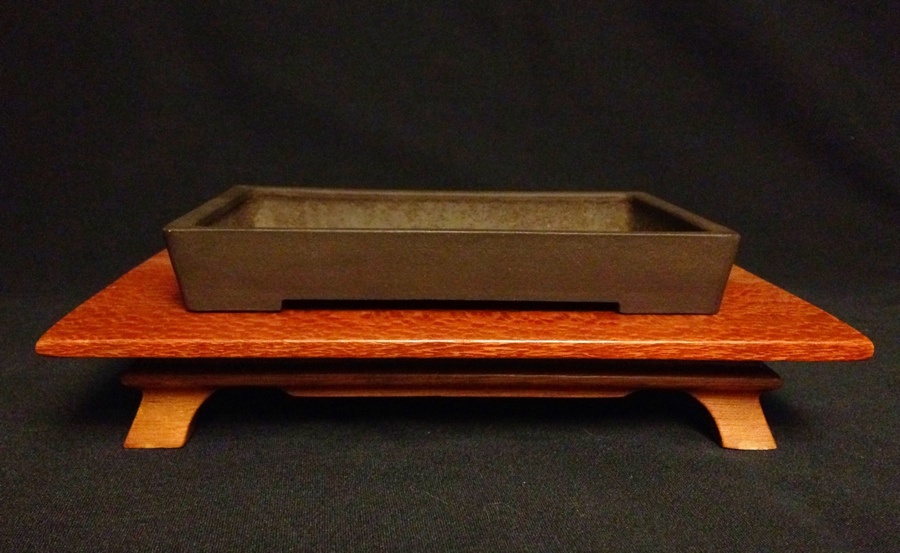
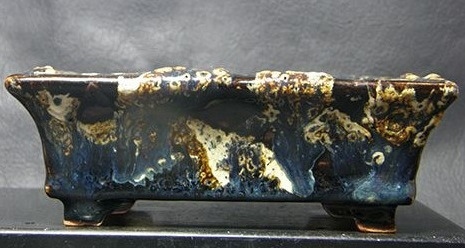
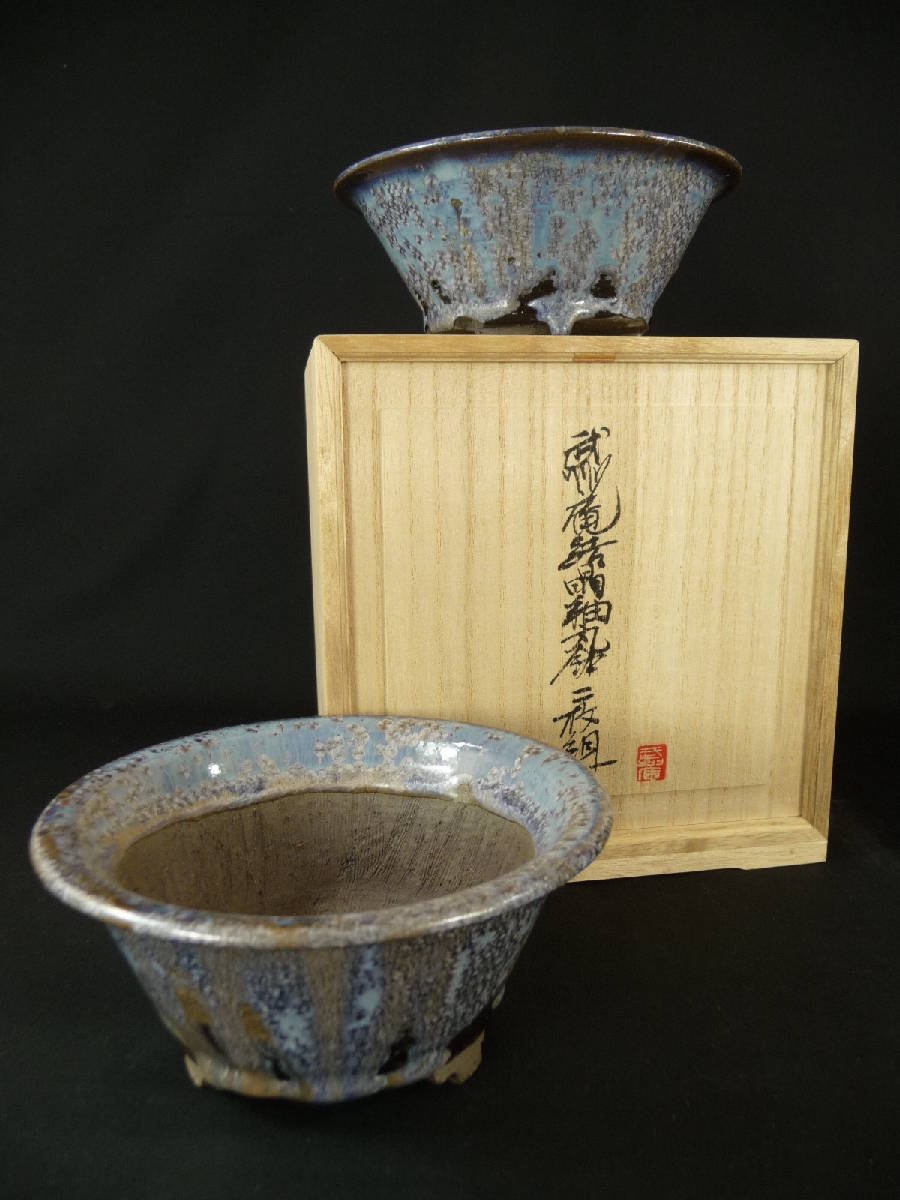
I’ve made no secret of the fact that I’m a rabid fan of the work of Shigeru Fukuda, who makes some spectacular bonsai pots under the trade name Bushuan. For a look back at some of the other Bushuan pots we’ve looked at on the blog, click here:
Bushuan Pots on the Blog
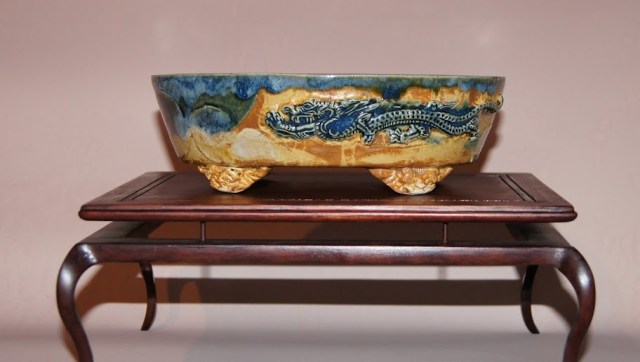
Now, let’s have a look at a few more pots from the contemporary master who is so often compared to Tofukuji, On to the Pots!

20130610-144854.jpg
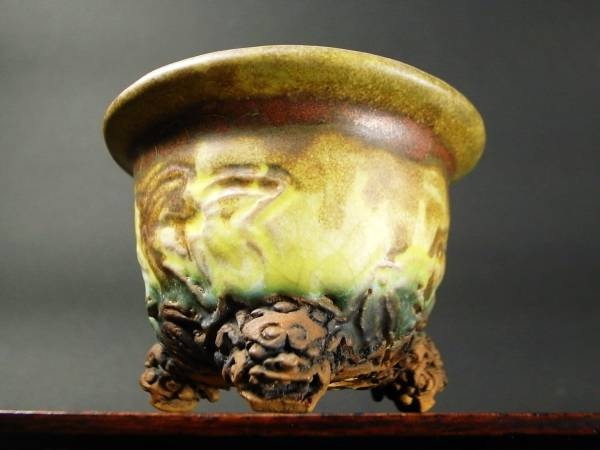
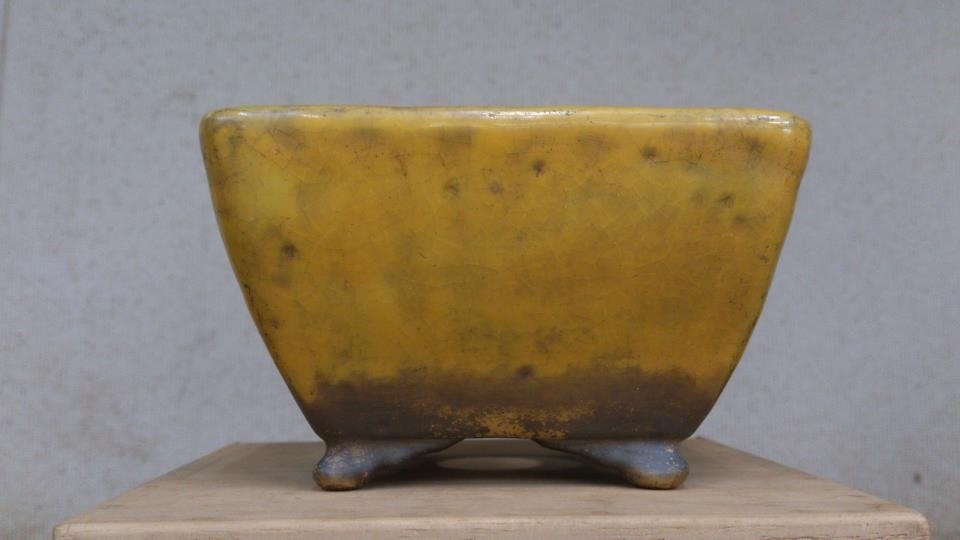
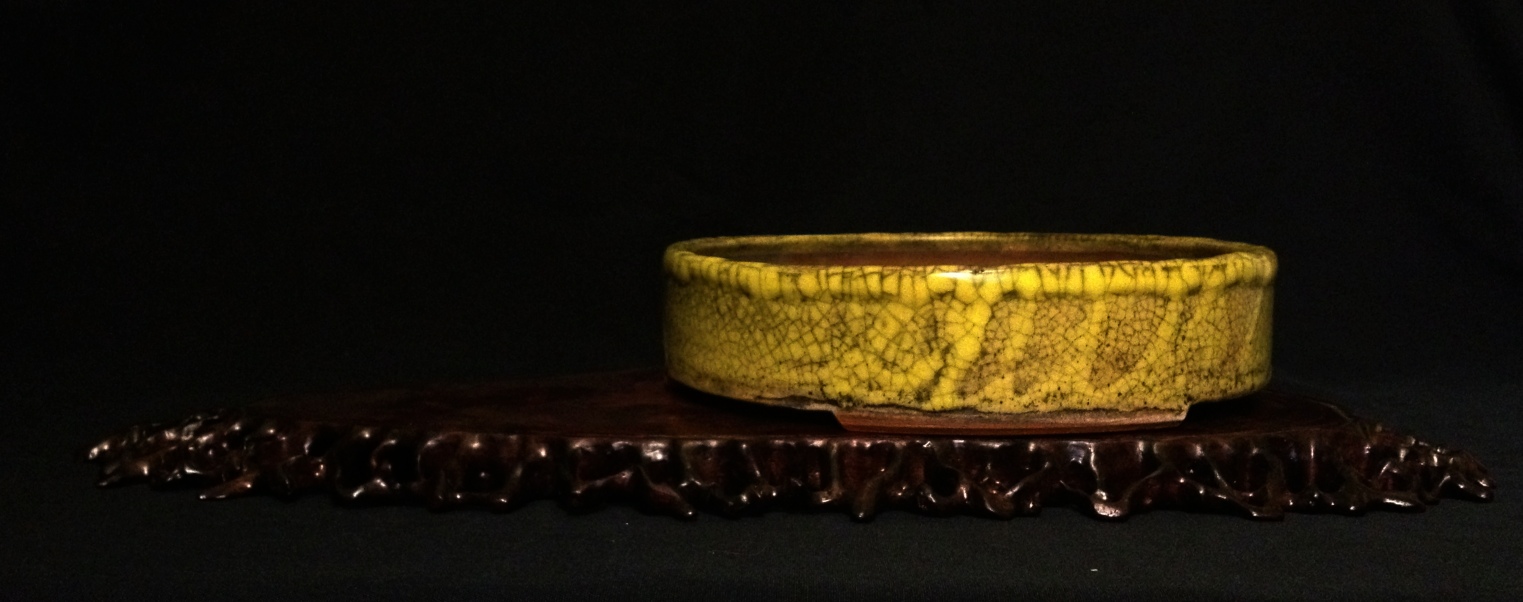
A round multiple glaze yellow crackle from my collection. The drips and runs to the different yellows are spectacular. Really a masterpiece. At 9″, one of the larger Bushuan pieces around.

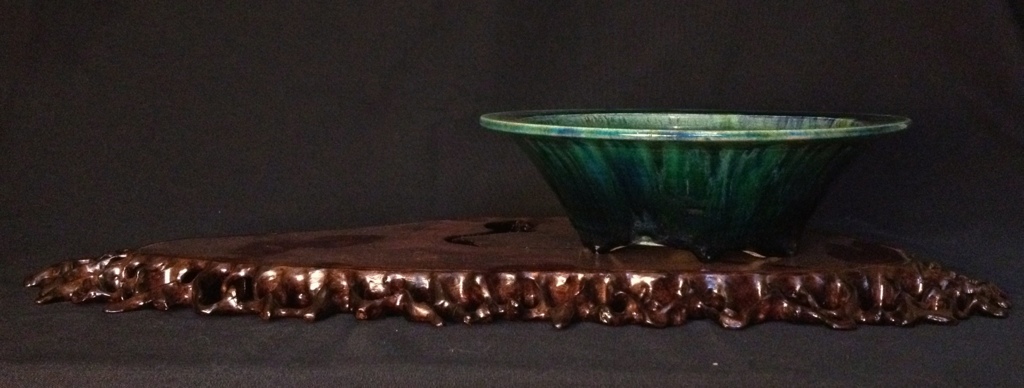
20130610-145110.jpg
A fluted round 8″ with vertical striping blues and greens from my collection. Another large piece, and really beautifully glazed.

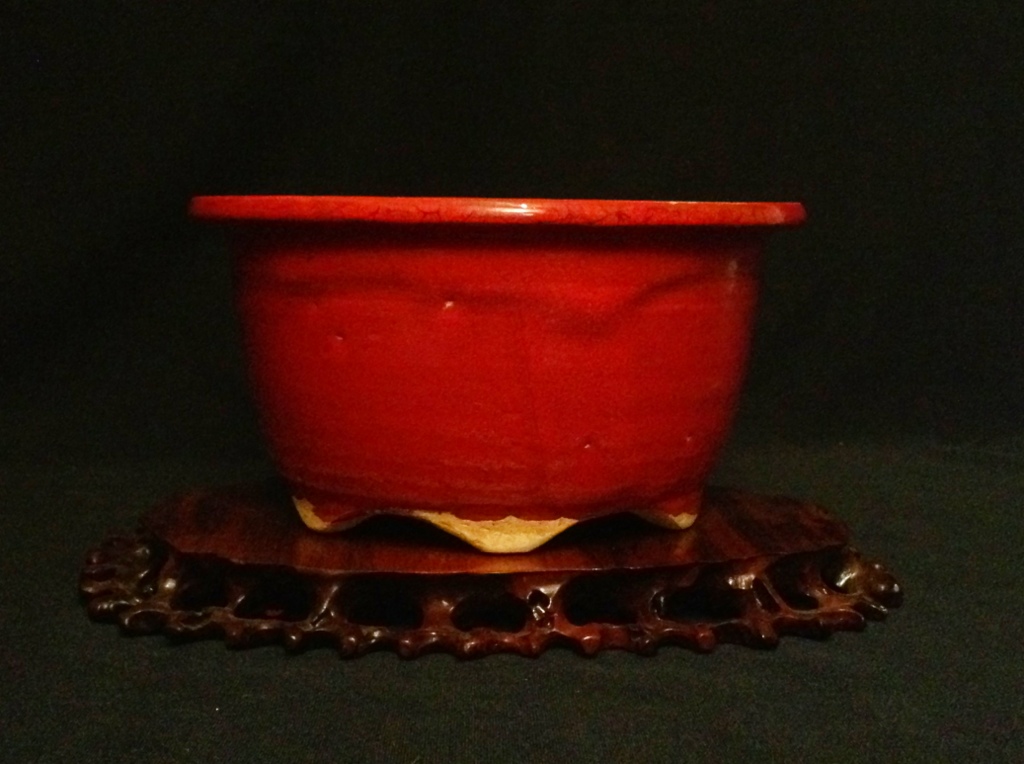
20130610-145226.jpg
A smaller rich red cascade style with tan clay exposed at the feet, from my collection. If you look close, you can see a line of running drip red glaze under the rim.

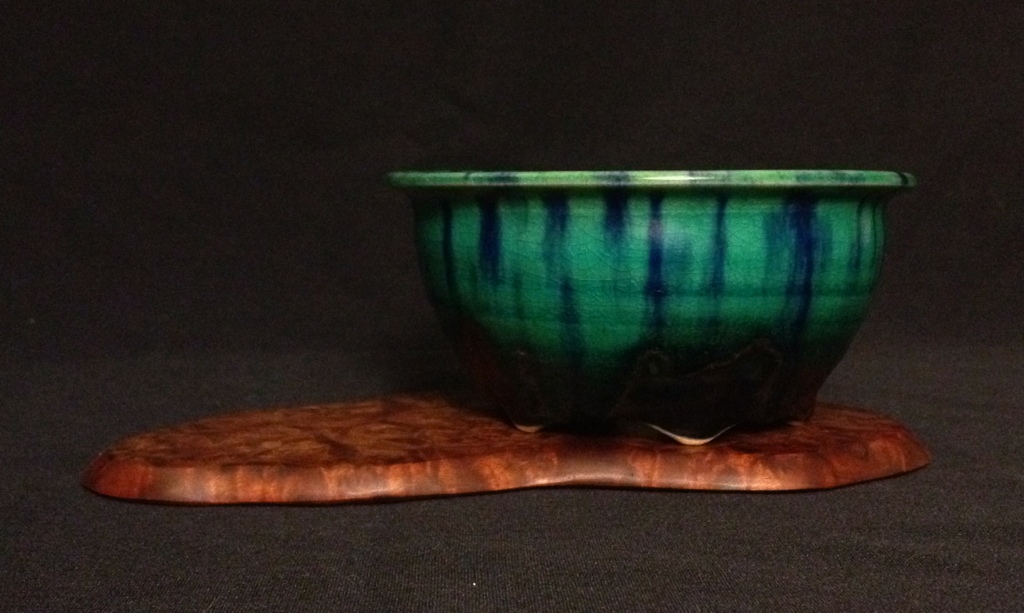
20130610-145419.jpg
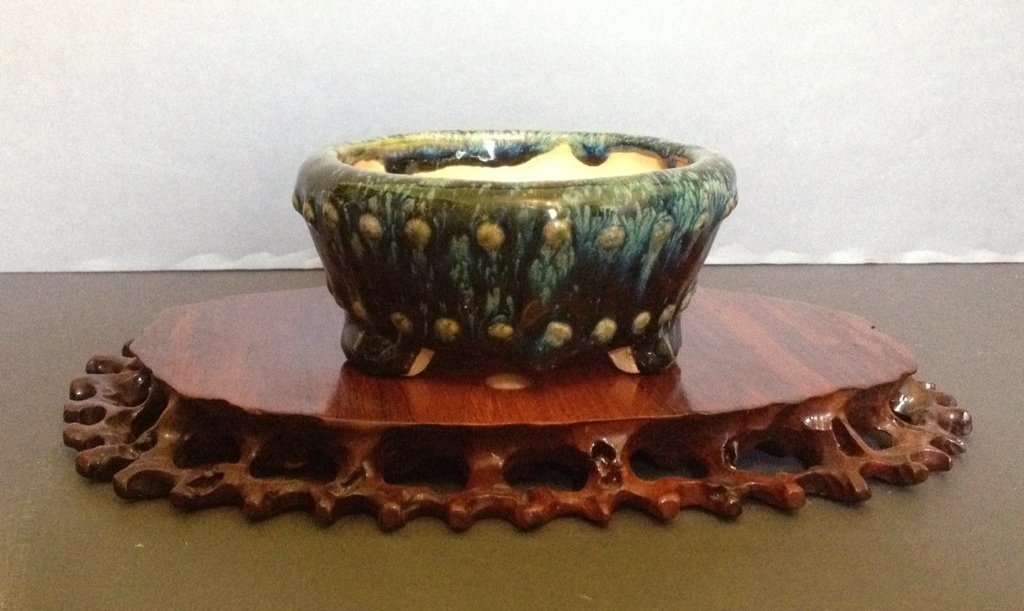
Another round cascade or semi cascade from my collection. Blue and green drip glazes over black. This one also has a nice patina beginning to show.

20130610-145558.jpg

20130610-145541.jpg
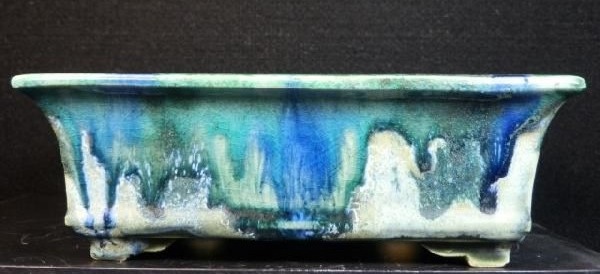
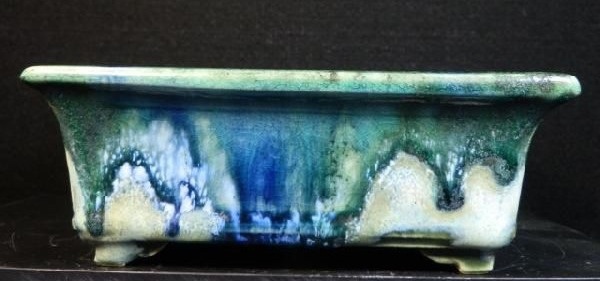
From two sides: a marvelously glazed rectangle Bushuan, with multiple blues, whites, and greens. Really spectacular multi color glaze.

20130610-145751.jpg
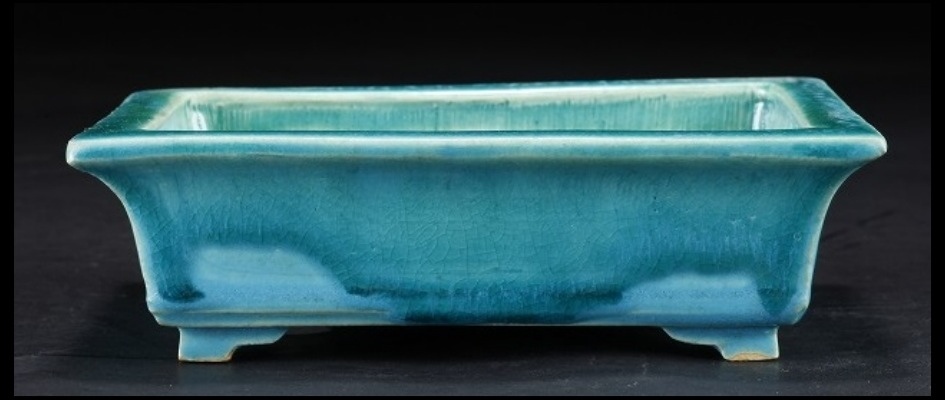
A more sedate Bushuan mokko shape with full cloud feet. Really pretty blue-green glaze.

20130610-145904.jpg

20130610-145911.jpg

20130610-145917.jpg
Two sides and the bottom of a really nice, large rectangle in one of Fukuda’s signature glazes.

20130610-150027.jpg
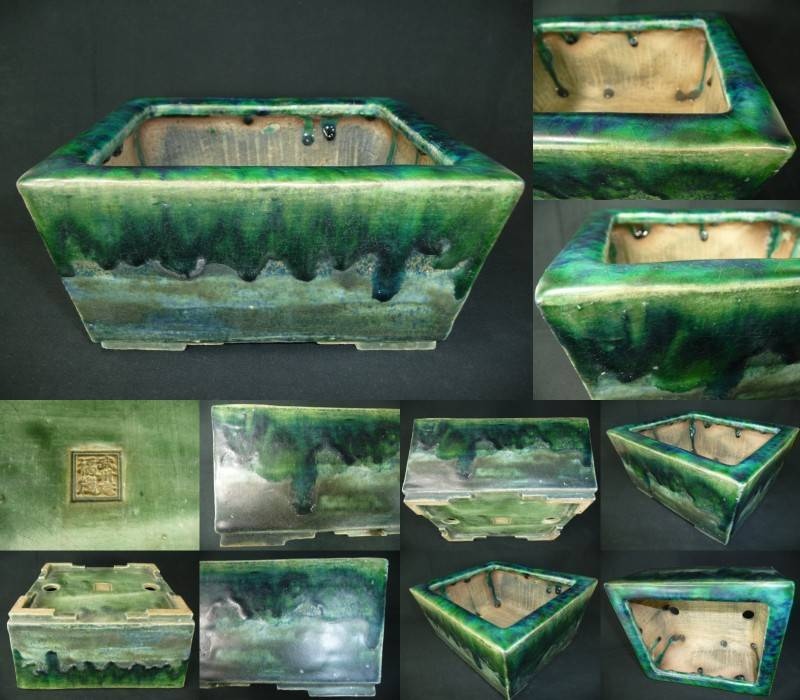
The same signature Bushuan glaze as above, this image showing multiple views of the fantastic drip glaze with its blues and rich greens.

20130610-150158.jpg

20130610-150204.jpg
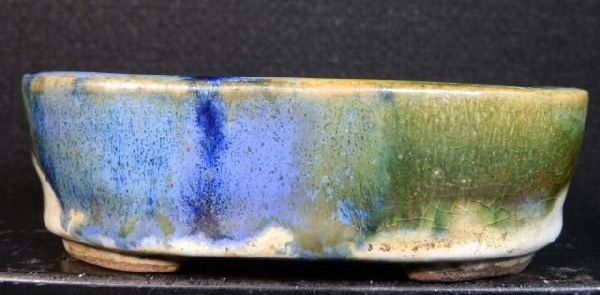
Front and back of a smaller Bushuan oval with more blocky swathes of color. Bushuan ovals are rare.

20130610-150301.jpg

20130610-150308.jpg
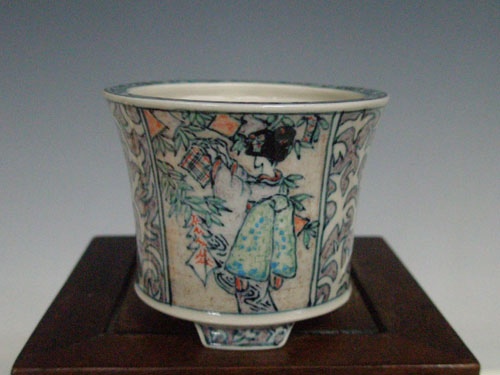
A painted collaboration piece from Bushuan and Mitsuko.

20130610-150401.jpg

20130610-150413.jpg
Front and 3 sides of a really nice double glazed Bushuan from Morimae at S-Cube. Really nice drips an complimentary colors.

20130610-150539.jpg
I may have shown this one before, but it’s worth a second look! The really beautiful marbling glaze is a study in balance!

20130610-150702.jpg

20130610-150708.jpg

20130610-150714.jpg
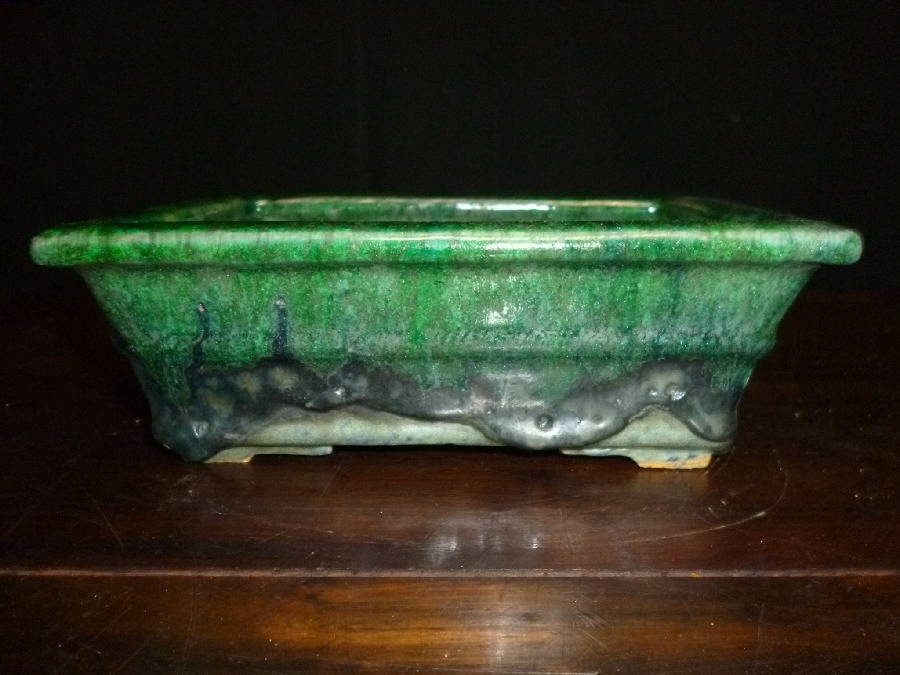
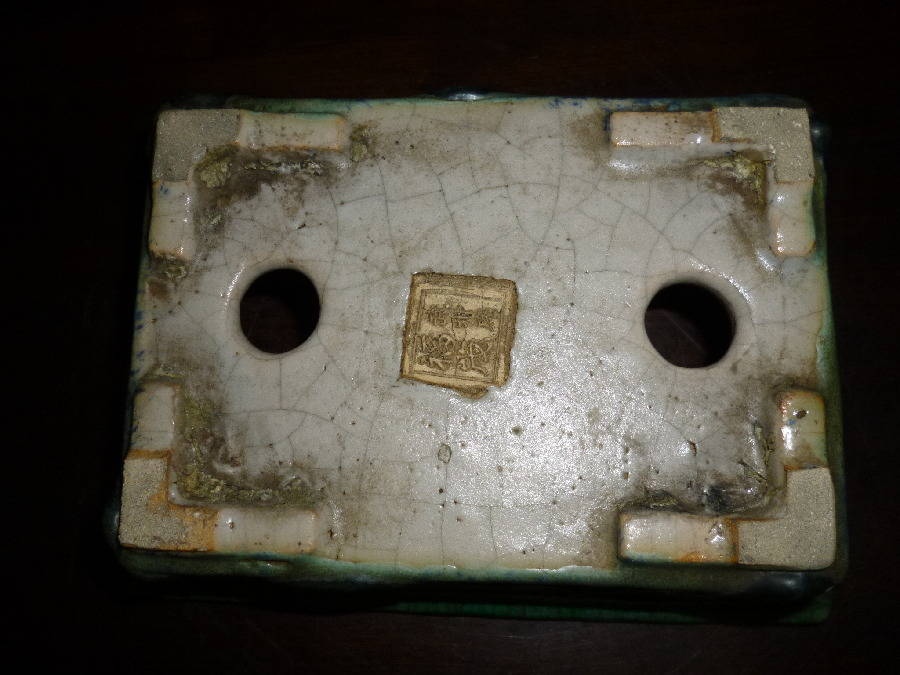
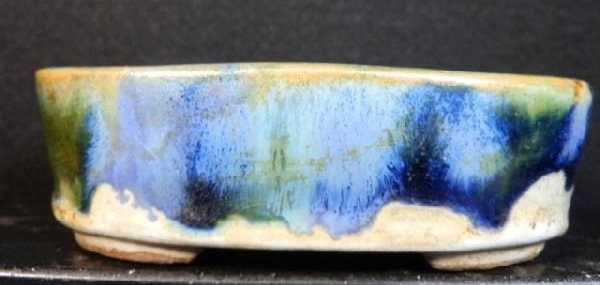
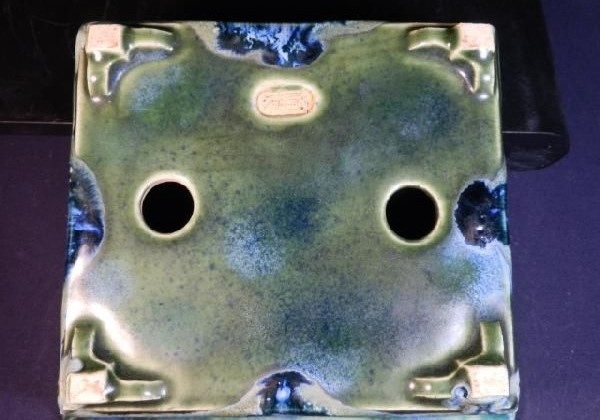
And we’ll finish up today’s look at Bushuan pots with this awesome cream glazed rectangle with multiple blue and green overglaze. Even the damn bottom is gorgeous people!

Thanks for having a look with me at some more pots from contemporary master Shigeru Fukuda! Thanks for reading!

Posted in Modern Potters, My Personal Collection | Leave a comment

New Pots Up for Sale!!!

After 6 months of hoarding, more than 50 pots now going up for sale on the For Sale page here at the site! I’ve listed 30 today and will list the rest tomorrow. You can check them out by clicking the “For Sale” tab at in the banner, or follow this link:
For Sale Page

Antique Chinese, famous old Japanese potters, famous contemporary Japanese potters, and production grade Tokoname. Have a look, there’s something for every budget!

20130610-142751.jpg

20130610-142806.jpg

20130610-142905.jpg

20130610-142932.jpg

20130610-143000.jpg

Posted in Famous and Antique Potters, Modern Potters, My Personal Collection | 2 Comments

Matsumoto Shouseki(松本松石)

Born Haruyoshi Matsumoto(松本治義)in 1940 in Shizuouka prefecture, Matsumoto Shouseki has been making Bonsai pottery, beginning as a hobby, since 1958. He was a new art exhibition co-winner in 1975, and has exhibited several times at the Shohin Kobachi Exhibition.
Initially he made only unglazed pots, but over time he has broadened his repertoire to include many various styles, including glazed pots and carved pots, but now specializes in painted and unpainted pieces made from native Arita porcelain, mostly in akae and sometsuke. In addition to making pots, these days he also spends quite a bit of his time teaching.
Now, on to the Pots!

20130608-130516.jpg
A small bag shaped pot with cloud feet painted with a spartan sometsuke landscape, from my collection. A very nice and tranquil seen is presented, and the shape combined with the feet is quite elegant.

20130608-130709.jpg
Front and back views of a lipped and bottom banded rectangle with cloud feet painted with flowers. A very nice patina to this piece, combined with the darker clay creates a striking effect of age.

20130608-140109.jpg
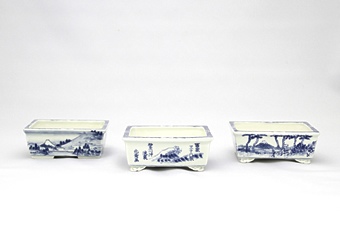
Three pieces from the last small pots Kobachi Exhibition.

20130608-140144.jpg
A tiny piece with ruler for scale, showing very well painted geometrics on a nicely executed cloud footed oval.

Now, before we get into anymore painted Matsumoto Shouseki pots, a little Japanese art history is in order. We’ve mentioned other painters of bonsai pots homage pieces to famous Scroll paintings and woodblock prints many times before on the site, and have even mentioned Tosui and his homage paintings to the works of Katsushita Hokusai. Matsumoto Shouseki is similarly entranced by the works of Hokusai, and has painted many homage pieces to the famous “36 Views of Mount Fuji”, a series of 19th century woodblock prints showing Fuji San from many different perspectives. For more on Hokusai and a more in depth look at his work, see
Katsushita Hokusai-Conplete Works

20130608-131551.jpg

20130608-131557.jpg
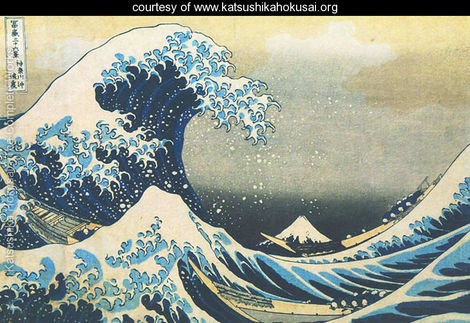
Two Hokusai originals from the “36 Views” series, for reference. The next several pots are all homages to this series of prints.

20130608-131726.jpg

20130608-131731.jpg
From the corner, front and back, of a Shouseki homage rectangle with cloud feet in akae. This piece is very intricately detailed, and shows either the above “Mount Fuji Seen Below a Wave at Kanagawa” or “The Great Wave Off Kanagawa”. The rear shows a smaller version of the Hokusai, and is calligraphically labelled as an homage to the print.

20130608-132349.jpg
Another homage to one of the same two prints, also in akae, this one a cloud footed mokko shape. The details in Shouseki’s paintings are very nice and well-painted, and while these pots are homages to famous prints, they definitely have their own style.

20130608-132549.jpg
A square homage pot, most likely to the print above, “Shower Below the Summit”. Interesting that Shouseki seems to have extended the lightning strike beyond the scope of the original.

20130608-132555.jpg
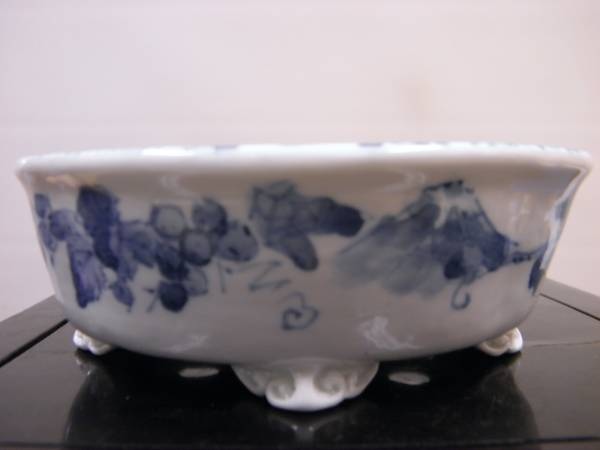
A rustically crafted cloud footed pot with a view of Fuji San.

20130608-133054.jpg
From the corner, a broader landscape view of Mount Fuji, with impressive detail and brushwork. I quite like Shouseki’s skill at creating both rustic wonky pieces like the previous pot and razor crafted straight line pots like this one.

20130608-133306.jpg
A round piece with cloud feet and a view of Mount Fuji with trees and clouds. The above piece has the “negative space” shaded with akae, which creates a totally different feel from landscapes against true white, like the pot before.

20130608-133530.jpg
A rather impressionistic view of Fuji San in sometsuke on a mokko shape with full cloud feet. A very pretty and stylized piece, when comparing with the above you can really appreciate Shouseki’s diverse styles.

20130608-133734.jpg

20130608-133740.jpg
Two totally different style views of Fuji San in sometsuke on identical pots, shown together to compare the different feel of the different paintings, all else being equal, literally. The spartan landscape of the first pot is light and airy and really feminizes the strong lines of the pot, while the second (“The Great Wave” again) is heavier and more masculine and would be better suited to a stronger tree.

20130608-134224.jpg

20130608-134230.jpg
A pair of glazed round pots with cut designs. Very interesting shapes and glazes to these two cascade or semi cascade style pots.

20130608-134351.jpg

20130608-134358.jpg
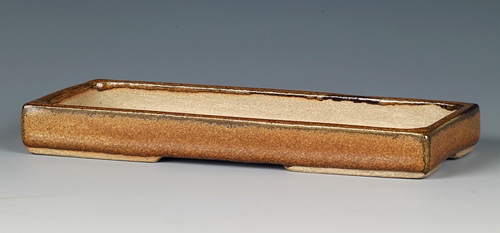
A pair of longer tray style glazed pots. I really like the glaze on the first piece, it’s metallic sheen is beautiful and deep.

20130608-134505.jpg
A pretty classical soft cornered rectangle with cut feet and deep, dark blue glaze. Shouseki has left the feet unglazed to show the quality Arita clay from which the body is constructed.

20130608-134637.jpg
And we’ll finish up our look at Matsumoto Shouseki with my favorite glazed piece of the bunch, a soft rectangle with a wonderful oribe over iron blue crackle, in the style of Wakamatsu Aiso. The depth of the iron blue glaze and it’s swirling patterns is impressive, and the green crackle is beautifully rendered and uniform. A wonderful piece showing great skill.

20130608-134942.jpg

20130608-135921.jpg
Matsumoto Shouseki’s signature and two stamps.

I hope you’ve enjoyed this look at the pottery and paintings of contemporary Matsumoto Shouseki, and his more than 50 years of Bonsai Pot creation!
Thanks for reading!

Posted in Modern Potters, My Personal Collection | 4 Comments

Okatani Zeshin Part 3

A while back, we looked at several pots from the master of surreal and interesting carved miniature pots, Okatani Zeshin. I received a lot of feedback and mail on those posts, so I’ve been putting together a few more pots for a while now.
A founding member of the Yokohama guild(an organization of potters making shohin and mini bonsai pots), Zeshin has influenced a generation of potters who specialize in carved pots. While his carving is extraordinary and unique, his glazing skill and recipes are every bit as fascinating, showing incredible depth, color, and control. It’s a real shame that he didn’t make any uncarved and easily usable pots with these glazes.
These links will take you for a look back at the previous posts for a refresher:
Pots by Okatani Zeshin Part 1
Pots by Okatani Zeshin Part 2

Now, on to the weird-ass pots!

20130524-123434.jpg
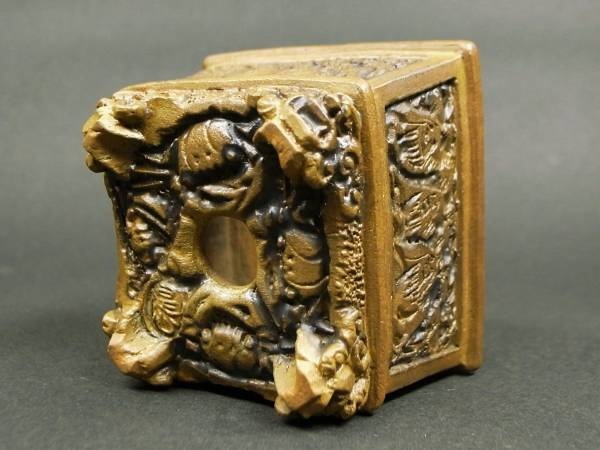
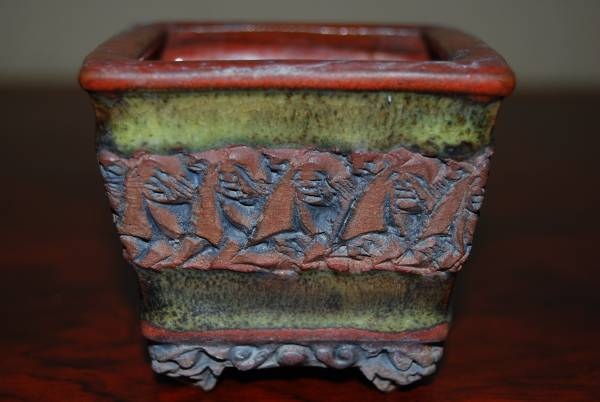
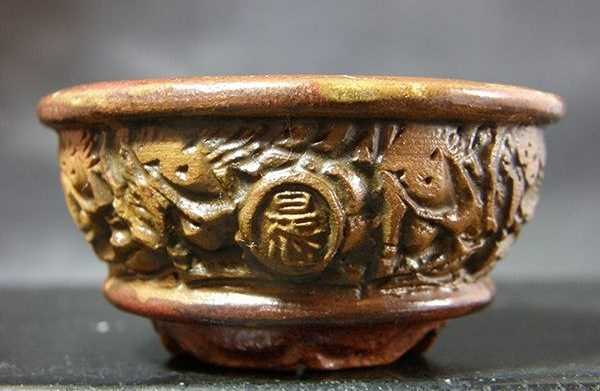
We’ll start off with this demon footed, lipped, unglazed sand colored clay square with repeating monks window relief carving, underside crabs, and multiple marks. Now that, is a mouthful of a pot description! The window relief carving I refer to as “repeating monks” was made famous by Chazan, and then taken to the extreme by Zeshin; in Japanese it’s called “百人”, which loosely translates to “hundreds of people” carving.

20130524-123926.jpg
A view from the corner bottom…the base is as intricately carved as the sides, with another Zeshin staple carving, angular crabs. Between the demon feet, the repeating monks, and the crabs, this pot is the most representative sample of Zeshin art that I have seen.

20130524-124531.jpg

20130524-124543.jpg
A few more views for good measure!

20130524-124703.jpg

20130524-124714.jpg
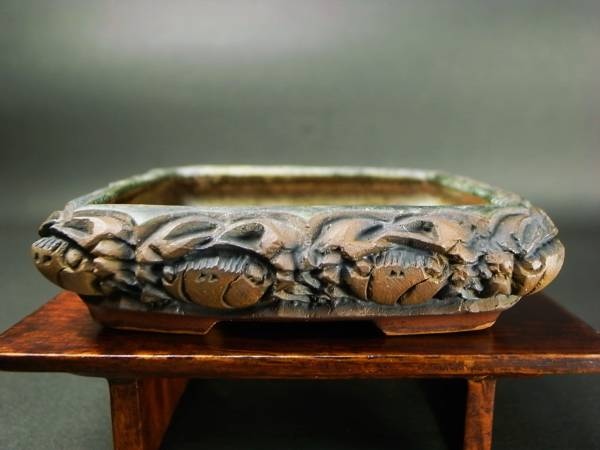
While the previous piece is certainly a tough act to follow, this piece is very nice. A rounded rectangle with angular base and multiple exterior wall crab carvings and underside carvings of crabs in a coastal landscape. Here we can see a little of Zeshins skill with glaze and finishes, in addition to carving: the slight notes of darker tint to the clay are interesting and create a cool suggestion of shadow and light. What I think is fascinating about this use of glaze is that appears to be of the same type often applied to pots as artificial patina, like manganese, but used here in a much more appropriate manner!

20130524-125522.jpg

20130524-125531.jpg
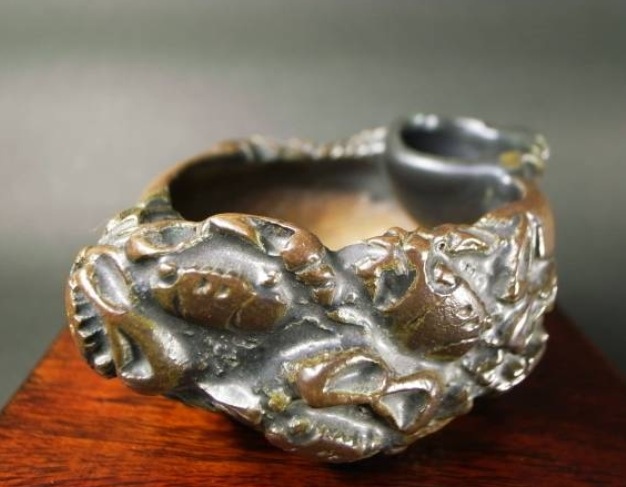
A really nicely carved crab round with Zeshin’s signature red and black glazes and a really unique little thimble for water.

20130524-125933.jpg

20130524-125939.jpg
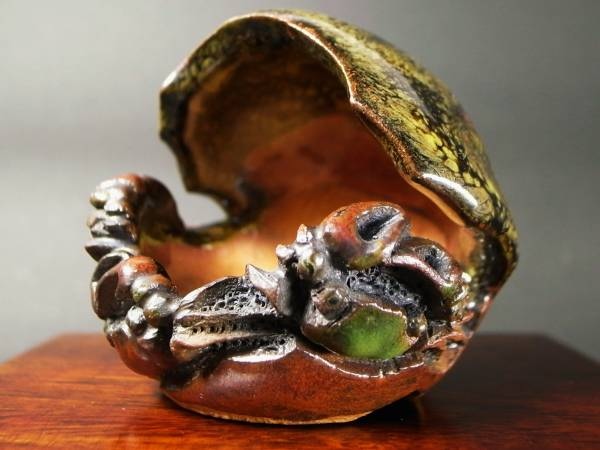
Two views of an eggshell or maybe clam shaped pot with multiple glazes and crab carvings. A really well made piece, the red glaze to the base is really set off by the yellow-shot-through-with-black glaze on the top of the pot. I know I can’t be the only one who sees these pieces and immediately calls to mind H.R. Giger’s fantastic and alien airbrush paintings.

20130524-130314.jpg

20130524-130320.jpg

20130524-131255.jpg

20130524-130326.jpg

20130524-130334.jpg
A trio of different rounds with octopi hanging off the sides, in 3 different Zeshin styles: angular and expressionistic, realistic, and cartoonish. The black and red over white glazes are go-tos in Zeshin art, and really create totally different feels for the pots.

20130524-131029.jpg

20130524-131036.jpg
A pair of repeating monks or “hundred people” carved pots. The multiple glazed square with demon feet is especially interesting, with it’s bands of glaze and relief.

20130524-131530.jpg

20130524-131539.jpg
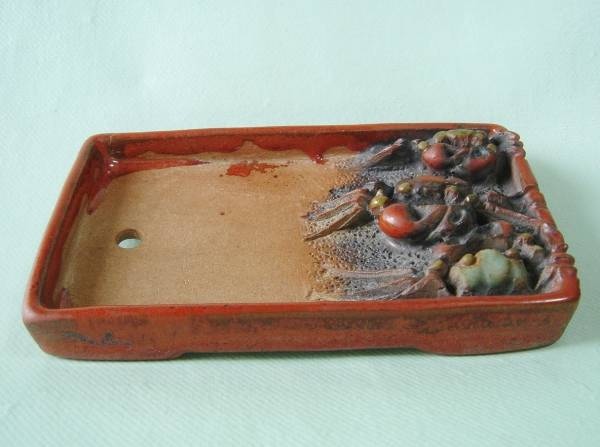
A shallow tray style glazed rectangle with crab figure carvings inside the pot, formerly of my collection. From the top you get a good idea of the size, one of the larger pieces in Zeshin’s portfolio. This would look awesome planted with some tall growing marsh grass or reeds, I think!

20130524-131829.jpg
A crab carved taller round with a very nice Namako type glaze. The way the glaze drips and runs around the crab is masterfully done, and the Namako itself really well made.

20130524-132048.jpg

20130524-132055.jpg
A glazed oval with a small crab carving detail, nearly invisible from the front. A more easily usable Zeshin, I think.

20130524-132215.jpg

20130524-132221.jpg

20130524-132229.jpg
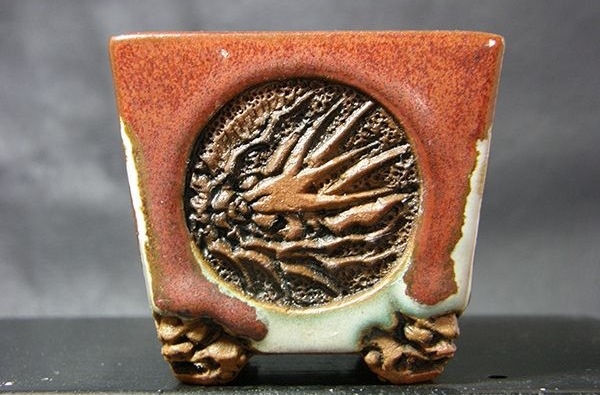
Three views of a round window relief carved square with demon feet in Zeshin red over white. The window motifs shown are Zeshin staples: dragons, “hundred people”, and dragonflies(not pictured).

20130524-133043.jpg

20130524-133105.jpg
Signed cloth and round window relief round pot with a really thick drippy black shot through with white glaze. The bluish lighting in this photo sucks, but it’s worth a look anyway for the really well executed thick dripping glaze.

20130524-133356.jpg

20130524-133405.jpg
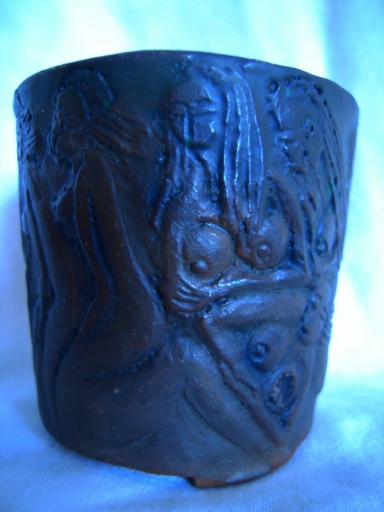
Two views of a more rare Zeshin motif: nudes. I’ve seen a few of these, but they’re not a common Zeshin subject. I find his nude figure carving a bit cubist and abstract.

20130524-133640.jpg
No look at Zeshin is complete without a figure pot! Zeshin animal pots include owls(look back at previous posts!), elephants, crabs, complete unknown fantasy animals and simple frogs, like this black glazed piece.

20130524-133904.jpg

20130524-133911.jpg
A pot that clearly shows the influence of the carver that came before: an obvious homage to the great nail carver and Tosui/Harumatsu cohort, Shinano Chazan.

20130524-134124.jpg

20130524-134130.jpg
A pair of early work Zeshin, the first previously of my collect. This type of clay and comparatively rough carving work is from Zeshin’s younger years, a totally different style and feel from his later work.

20130524-135912.jpg
A taller lipped round cascade with demon feet. The glaze covers some deeply inset relief carving, a really nice effect.

20130524-134352.jpg
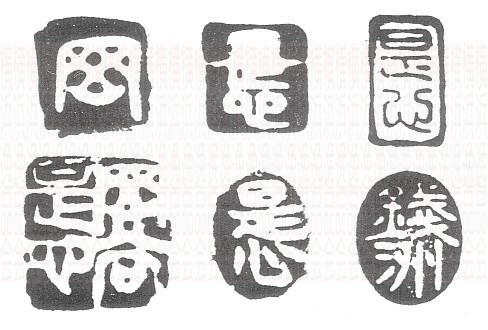
Zeshin’s most common seal amongst relief carvings.

20130524-134504.jpg
The most often seen Zeshin stamps. Many Zeshin will have nail carved signatures in addition to these marks, and many pots will have more than one stamp.

20130524-134633.jpg

20130524-134640.jpg
And we’ll finish up today’s look at Okatani Zeshin with these two sides of crab-carved-corner square cascade with demon feet and inset panels. The two sides show the crab carved into the corner as well as the different glazes on each side.

20130524-134945.jpg
From the corner, it’s easy to see the two different glazes and the crab and demon head on. Really interesting contrast and compliment.

I hope you’ve enjoyed this look at the surreal and odd carved pottery of Okatani Zeshin. Thanks for reading!

Posted in Famous and Antique Potters | 7 Comments

Shun(俊)

Born in 1940, Shigetoshi Yamada makes and paints pots under the trade name Shun(俊). He started creating bonsai as a hobby in 1975, and first began making pottery at a Fuji City Museum pottery class in 1992. By 1995 he was in full scale production of handmade pots. He’s been featured multiple times at the Gafu Ten exhibition of small bonsai pot artists. Today we’ll take a look at some of his work. Now, on to the Pots!

20130522-180858.jpg

20130522-180903.jpg
These two images come from the 2011 and 2012 Gafu Ten Kobachi exhibition. A good cross section of his work, which is varied and includes multiple styles of painting, in addition to porcelain relief carving.

20130523-084924.jpg

20130523-084931.jpg
Two sides detail of the figure painted cascade featured at the Exhibition. The figure painting is detailed and there is also a very nice use of traditional geometrics. The style feels very old school to me, like old scroll paintings(that’s a good thing!).

20130523-085158.jpg
Detail of the celadon porcelain relief pot featured at one of the exhibitions. It’s rare to see a potter who is as skilled with the brush as with the knife, the short list includes notables Sano Daisuke and Yusen. The relief is very well carved, and shows great depth in a medium where that is a challenge!

20130523-085411.jpg
A sometsuke footed oval painted with waterscape and boat. Very richly detailed with interesting and rather heavy handed brushwork in the foreground, and delicate brushwork to the far mountains, creating an interesting depth.

20130523-085534.jpg
A lipped semi cascade square with painted landscape. It’s pretty rare to see a window landscape surrounded with sometsuke, if you you look closely you can see that the entire pot is painted with the same underglaze enamel used in the landscape. The landscape is more delicately painted than the above pot, though the same use of heavy and light brushwork creates the same depth. An interesting contrast in style.

20130523-090032.jpg
A five color footed rectangle with dragon figure. Very spartan use of color, which serves as a great accent, brightening up an otherwise drab blue with splashes of yellow. I’ve seen this same dragon painted by Ranzan, Shunka Shozan, and several other painters; I assume they are copies of a famous scroll painting, but haven’t pinned down the original.

20130523-090344.jpg
A fairly simple round with lip and traditional Kyoto style geometrics. Precise and intricate.

20130523-090552.jpg
A tiny Shitakusa for small shohin or mini bonsai display. The painting reminds me of the smaller works of Sano Daisuke, who paints tiny accents with fish in the same style.

20130523-090642.jpg
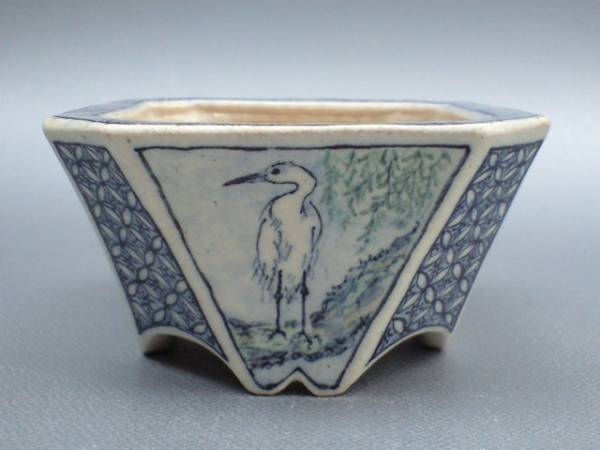
A six sided cascade with traditional geometrics and an osprey or crane. Very delicate and soft brushwork to the figure painting, and a very well made pot.

20130523-090907.jpg

20130523-090914.jpg
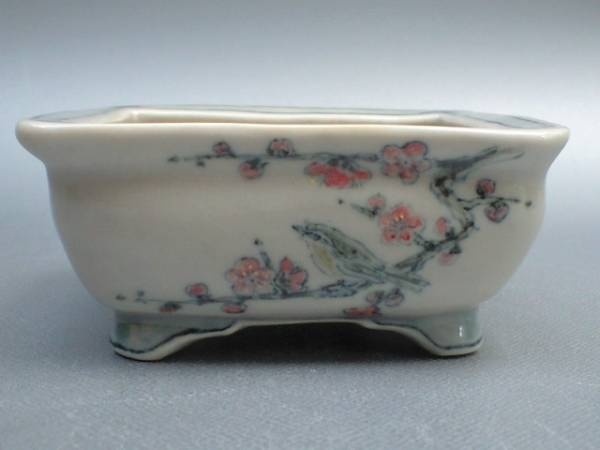
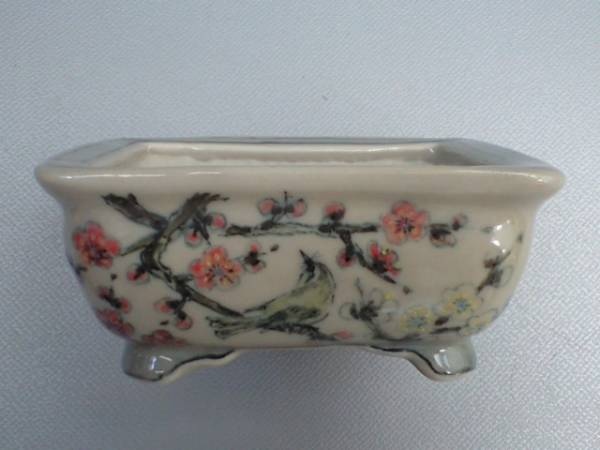
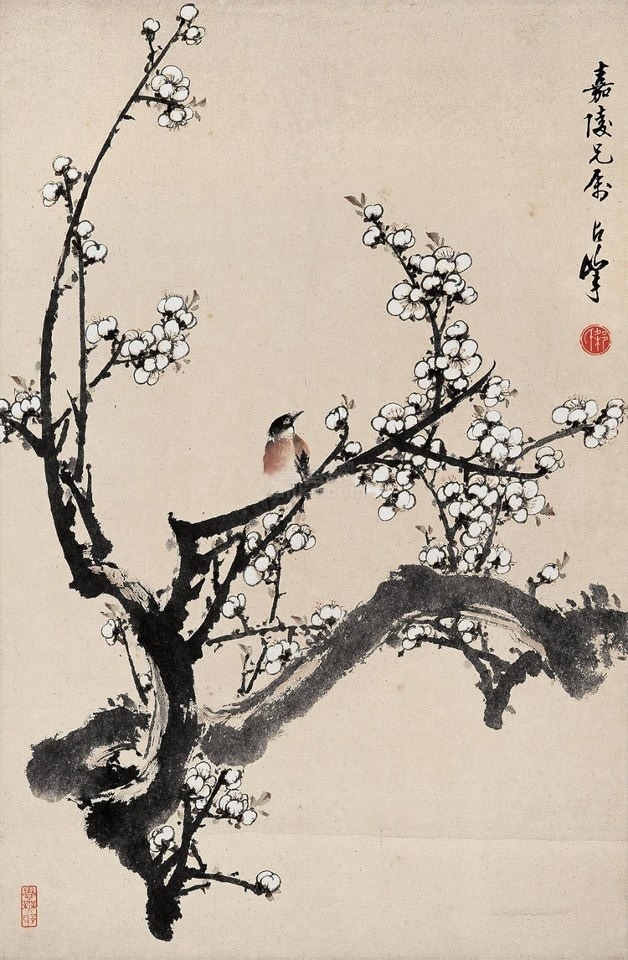
Two sides of a celadon porcelain pot with Ume and sparrow. Interesting that the opposite sides have such a different feel: heavy and light. The gold overglaze enamel details to the Ume flowers are a great touch! Another piece that is very strongly reminiscent of old Chinese and Japanese scroll paintings.

20130523-093348.jpg
Scroll painting by Liang Zhanfeng for comparison.

20130523-093504.jpg

20130523-093510.jpg

20130523-093515.jpg

20130523-093521.jpg
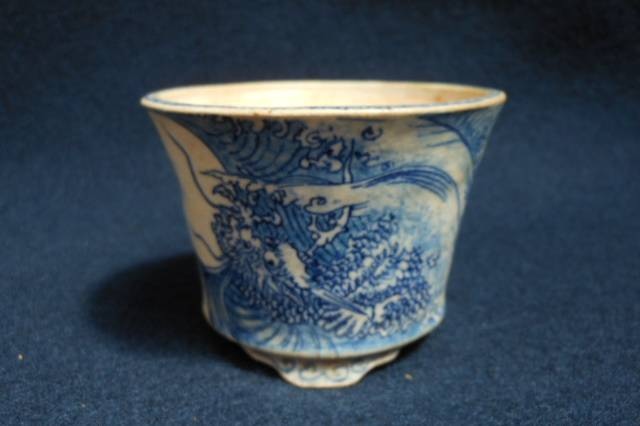
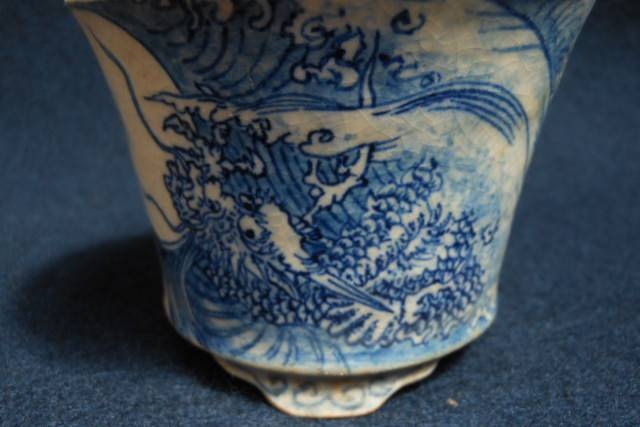
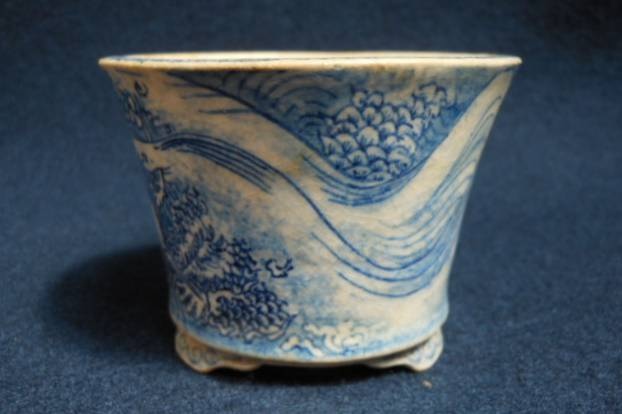
Multiple views of a round cascade fully painted with an interesting and rather fleeting dragon. Clearly earlier work, this pot must have been in use every day for the last 20 or less years to get a patina like that on porcelain! The painting itself is delicate and suggestive, and many of the details bring to my mind the wave painting style of Katsushita Hokusai.

20130523-093816.jpg
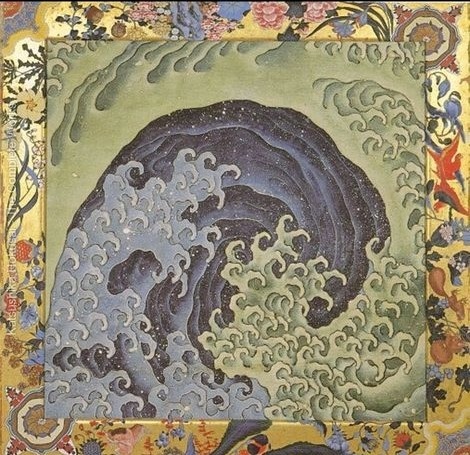
“Menami”(feminine waves) by Hokusai

20130523-093917.jpg
Base of the celadon rectangle above, showing Shigetoshi Yamada’s mark: “俊”(Shun).

I hope you’ve enjoyed today’s look at the work of contemporary painter and potter Shigetoshi Yamada! Up next: Pots from My Collection and Antique Chinese Pots. Thanks for reading!

Posted in Modern Potters | 2 Comments

Glazed Pots by Heian Tofukuji 4

Heian Tofukuji is considered the epitome of Japanese style and taste for bonsai potters. Perhaps no one has been more influential in the development of contemporary Japanese style of bonsai pottery. We’ve looked at him a great deal before on the site, and today we’ll take a look at a few more glazed pieces, and in another post this week, we’ll look at some images of trees in Tofukuji pots from major exhibitions. For more history on Tofukuji, and other pots, take a look back at these posts:
Glazed Pots by Heian Tofukuji
Glazed Pots from Heian Tofukuji 2
Glazed Pots from Heian Tofukuji 3
A few more interesting tidbits have surfaced since those posts. For example, Tofukuji clay: the pitted and rustic look on many Tofukuji pots likely comes from “chamotte”. For the most part, chamotte is charcoal or wood or some other substance mixed into the clay to make it stretch. Not physically, as in elasticity, but monetarily, as in Tofukuji lived in abject poverty. In addition to chunks of things that would’ve burned away in the firing, Tofukuji used Ground Antique Chinese Pots as a kind of chamotte, to cut the expensive clay. Likely shards and fragments of broken pots, rather than whole pots, but still a fascinating tidbit of information. So, don’t fret about the price tag on that Tofukuji, because you’re getting not only a Tofukuji, but an antique Chinese pot to boot!
Now, on to the Pots!

20130519-134423.jpg

20130519-134431.jpg
A rich green glazed Tofukuji with silver oil droplets, the glaze that made him famous. The crackle glaze is thick and the drips showing at the base are awesome!
Note the signature: these days, it’s been reported that forgeries have been spotted with signatures created using machine routers and pots that resemble Tofukuji’s work. The signature in these will be identical to the real thing, but for one detail: signatures carved into the clay before firing will have some waves around the lines, the result of clay displacement. Cut signatures won’t. Saavy? Good.

This is perhaps the most imitated and emulated glaze among contemporary potters, one can see examples from 3rd generation Shukuho, Ikkou, and Koyo; though none quite hit the mark(though Ino Shukuho comes pretty close). The reason for this is a simple one: Tofukuji burned the significant majority of pots with these type of kiln changed glazes in Noborigama, or a wood fired climbing kiln. Wood fired kilns of this variety are no longer legal in Japan, due to environmental regulations, so, while many potters emulate Tofukuji glazes with gas and electric kilns, they never come close to the complexity produced in the Noborigama.

20130519-135038.jpg

20130519-135046.jpg
Two views of another interesting Yohen rectangle. The running rivulets of glaze are quite beautiful, and the silver crystalline surface accents really lovely. Masterpiece.

20130519-135218.jpg
A deeper blue rectangle, with a very thick glaze that is deep and shallow at various parts. A Complex and unique glaze.

20130519-135339.jpg

20130519-135346.jpg
Two views of a multiple glaze shallow oval. This style of glaze is a Tofukuji original, and can frequently be seen in the work of Echizen Bunzan and Fukuda Shigeru.

20130519-135531.jpg
A larger cut footed round with lip, glazed in a darker oribe-blue with fine oil droplets and silver surface crystals. A very beautiful and functional pot, I’ve seen this one, or similar, used in several Kokufu Ten exhibitions.

20130519-135751.jpg
A similar shape and size as above, this one with a much more muted glaze, pitted and more rustic.

20130519-135838.jpg
A more fantastically glazed round pot. The swirling colors and expert application are very nice. It bears mention that, other than some of the most famous antique Canton ware glazes, pots with multiple color glazes like this weren’t often seen when Tofukuji made these pots. While today we see pots with some really spectacular and unique glazes, in Tofukuji’s time this was revolutionary.

20130519-140203.jpg
A hand formed cream glaze cascade with Tofukuji’s signature style of cloud feet. These days, one can see this type of feet on pots from many potters, all homages to Tofukuji’s style.

20130519-140343.jpg
A very rare style and glaze from Tofukuji, this one with 4 of his signature style cloud feet on a round pot. Much more refined and sharp than common Tofukujis.

20130519-140443.jpg
A simple cream glazed crackle rectangle with cut corners and feet. The patina in this piece is lovely.

20130519-140537.jpg
This photo comes to us from Peter Warren, from this years Kokufu Ten. I believe it’s from Koju En’s sales table. A pair of glazed Tofukuji lipped ovals, with cut style stepped feet, in blue and cream. All I can say is “droooool”.

These next images come from Ayumu Fukano, master at shohin specialist nursery Yorozuen. I’m sure we all know who they are 😉

20130519-140759.jpg

20130519-140807.jpg
A really awesome combo: signature style and shape Tofukuji blue, with a stand made and signed by Tofukuji himself. This has got to be a one of a kind!

20130519-141105.jpg
A multi color glazed tall round with Tofukuji cloud feet. See above for an idea of how revolutionary this type of glaze was. Many potters have emulated this style, Bushuan and Bunzan kilns notably so; while Bunzan falls a bit short of the originals, Bushuan much less so!

20130519-141518.jpg
A cream Glazed rectangle with a large swath of blue glaze….

20130519-141842.jpg
My logo tree, a Miyasama Kaede in a Bushuan pot. It’s well documented that Fukuda Shigeru is a fan of Tofukuji, but it’s nice to see an homage and an original together side by side for comparison.

20130519-142108.jpg
A very rare style and glaze from Tofukuji. Cascade riveted drum with double bands, lip with hemp rope detail, and Tofukuji cloud feet. I’ve seen but two of these, the other a green in “3”.

20130519-142316.jpg
This is something different and unique! The larger cavity has drainage, the smaller a pool for water…the first land/water penjing! While there are a few around, the crab detail(which, from studying others as well as Jr in my collection, I believe were press molded) is rare as well.

20130519-142646.jpg
Now that, boys and girls, is a set!
Painted Tofukuji are rare, and It’s believed that someone else painted Tofukuji pots that are painted(and I believe there are at least 2 different painters from the styles I’ve seen) no one is sure who really painted them. I’m not sure why the experts believe Tofukuji didn’t paint them, perhaps Mr. Warren will chime in in the comments.

20130519-143035.jpg
Here is the bottom of one of the pieces in the set. These are the common Hanko on painted Tofukuji, and from the number on the top we can see that this set is formerly of the Takagi Collection.

20130519-143240.jpg
This is another unique piece, with a lovely glaze. This shell shaped pot has a small loop for hanging, for cascading style bonsai or accents. Even today, this would be considered Avant Garde.

20130519-143523.jpg
A really nicely glazed green Tofukuji oval with cut feet. This is probably the second most common style of shohin Tofukuji, the most common being tiny Terebineri rounds. The patina on this piece is lovely.

20130519-143735.jpg
A cut footed rectangle with thick green glaze that has blue highlights. On the exterior of the pot, the blue has disappeared and become a deeper green, masked by patina; if you look closely, you can still see the original blue highlights on the interior rim where patina doesn’t build(counter intuitively).

20130519-150253.jpg
A very thickly glazed Tofukuji rectangle with cut feet, in an oribe with fine oil droplets, silver crystals, and somehow, notes of gold! A prime example of why Tofukuji is considered the pinnacle of bonsai pottery in Japan.

20130519-144054.jpg
And we’ll finish up today’s look at Tofukuji glazed pots with a very rarely seen yellow semi cascade square, showing a wonderful patina. I’ve seen exactly one yellow Tofukuji, outside of books. The rarest of the rare!

Thanks for taking a look at some more Glazed pots from master potter Heian Tofukuji! I hope you’ve enjoyed them!

Posted in Uncategorized | 6 Comments

Hikosanjin(彦山人)

The full name of his kiln is 久保田彦山人(Kubota Hikosanjin), and he was born 久保田信彦(Kubota Shingen) in 1933, in Chiba prefecture. Hikosanjin has been painting and making bonsai pots since the 1970’s and is especially well known for painted celadon and akae(red) paintings. He first exhibited in the Keisei National Small Pots Masterpiece exhibition in 1981. Hikosanjin paintings show very fine line detail and brushwork, and are very classical and simple, much more like traditional ink paintings than some of the more detailed and naturalistic painters we’ve looked at on the site.
Now, on to the Pots!

20130517-132104.jpg
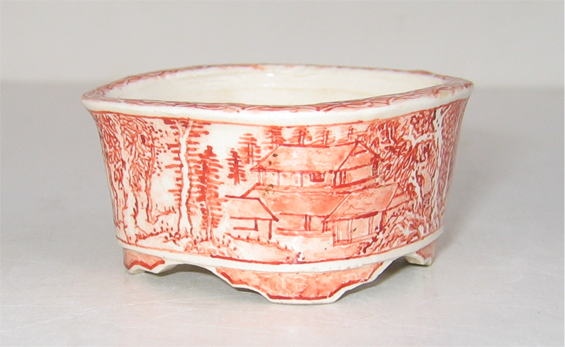
A Hikosanjin painted collaboration pot with Tokoname potter Hattori Tomoyuki, from my collection. Here we can see Hikosanjin’s delicate and fine lined painting style and particular skill with Akae overglaze enamel. The sense of depth created in the painting by the rivers winding away into the distance is well done.

20130517-132401.jpg
A go-sai mokko pot with feet, in my collection. Another collaboration from Hattori and Hikosanjin. The richness of the colors is very nice, and very detailed for such a small pot.

20130517-132614.jpg

20130517-132620.jpg
Two sides of a sometsuke oval, made and painted by Hikosanjin. The softness of the painting is exquisite, though also highly detailed, and a nice patina is beginning to form.

20130517-133154.jpg

20130517-133159.jpg
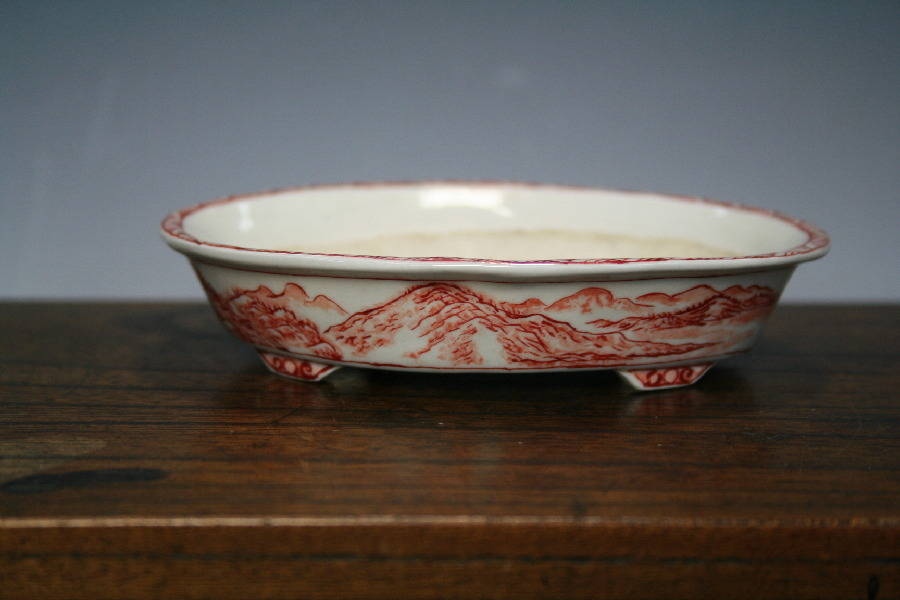
An Akae overglaze painted oval. The detail and fine brushwork are beautiful, and the feet nicely detailed. Like the previous piece, one side is majestic with negative space, the other busy and near view. I really like the majestic mountain side.

20130517-133610.jpg
A deep indigo painted landscape scene, the stark use of line and form create a wintery and forbidding landscape to me.

20130517-133920.jpg
A muti color cascade style with window landscape. The use of bright color in swaths really “springs” up the image, an interesting contrast with the previous pot.

20130517-134048.jpg
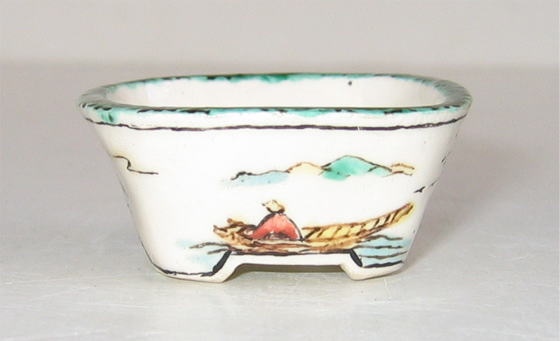
A very simple small 5-color with boat and pilot and very few surrounding details. An interesting use of space, suggesting open water.

20130517-134216.jpg
Another sometsuke oval, this landscape with it’s deep valley and river winding away into the distance creates a great sense of depth in the painting.

20130517-134600.jpg
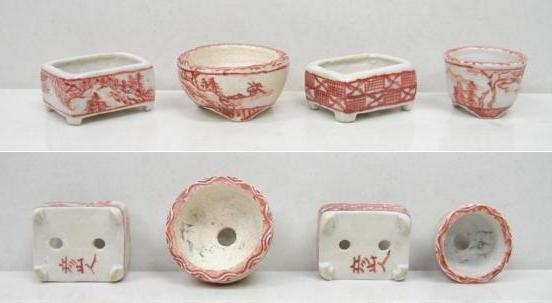
A quartet of Akae painted accent pots. Interesting for comparison of Hikosanjin’s variable style.

20130517-134703.jpg
Another Akae painted pot, this one a square, from the corner, showing a really lovely near view of a house clustered in a copse in the forest. The trees are wonderfully detailed, and I really enjoy how they are rendered with such simple lines, for example, note how the bulk of the trunk is actually negative space, the image created by outline.

20130517-134843.jpg
A cascade or semi-cascade round sometsuke painted pot. The feet are gorgeously painted, and the mist shrouded mountainous landscape with its lone copse is beautiful.

20130517-135150.jpg
And we’ll finish up looking at Hikosanjin painted pots with one last Hattori Tomoyuki/Hikosanjin collaboration. Bright swaths and blocks of color make this painting festive, though the colors aren’t overused to the degree that the pot is difficult to use. I think the glaze and clay color used by Hattori mute the bright colors a bit, which would, perhaps, be a bit cartoonish over white porcelain.
Hikosanjin Hanko and Rakkan

20130517-135613.jpg

20130517-140653.jpg

20130517-140710.jpg
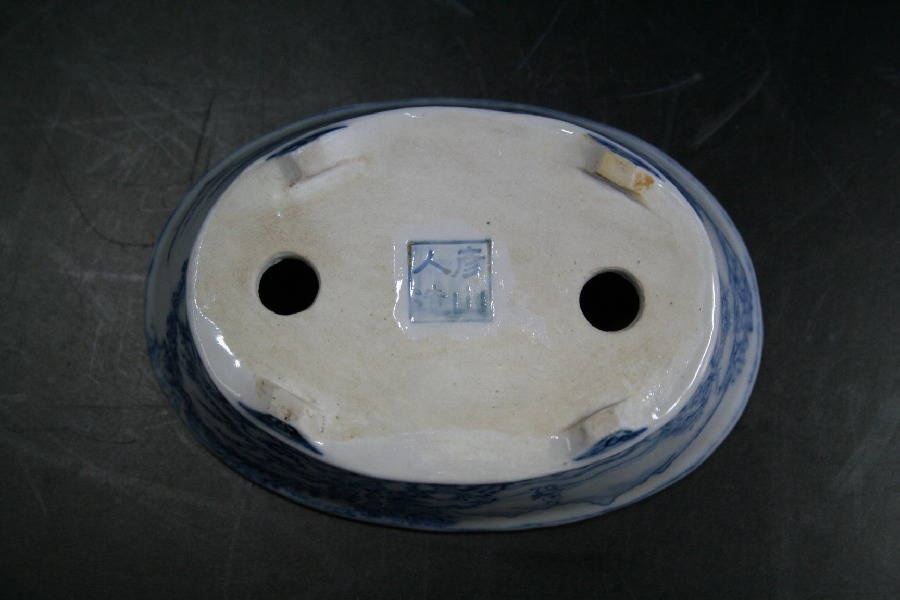
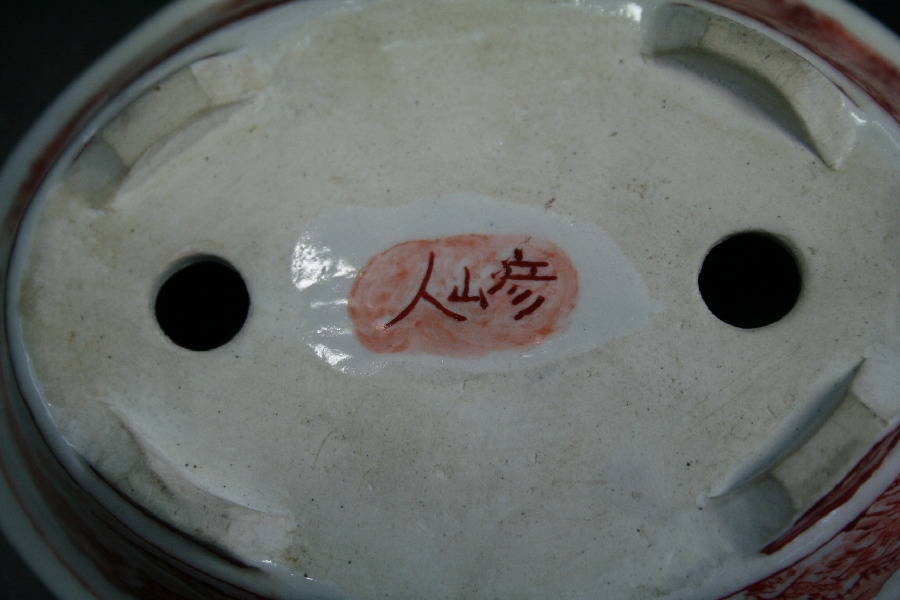
Three marks on pots made and painted by Hikosanjin. Note that some are both nail carved and painted.

20130517-135918.jpg
Hikosanjin signature peeking through the landscape on a Hattori collaboration pot.

I hope you’ve enjoyed this look at the painted pots of Kubota Hikosanjin. Up next, Antique Chinese pots and some famous Kutani Yaki.
Thanks for reading!

Posted in Modern Potters, My Personal Collection | 1 Comment

Painted Pots from Shunka Seizan(Update 5/11)

A while ago, I posted pots from my collection of Shunka Seizans. The original post can be found here:
Shunka Shozan(駿河政山)

They were all kiln change glazes, very Tofukujiesque. Around 6 months ago, painted pots from this talented potter began appearing, so I thought I’d share.
Here’s an excerpt from the original post:
“His real name is “河村 政春” “Kawamura Seishun”. A veteran of more than 40 years as a bonsai grower, enthusiast, and lover, he is especially known for his maples. Seizan began making pots as a hobby 6 years ago. The works are all single block carved, and feature some of the best glazes I’ve seen from any modern potter, both in kiln change type glazes and clean, pure colors. Most of his glazes are kiln change type, in the best Japanese tradition of Tofukuji.”
Now, on to the pots!
Wait. Not quite. Let’s back up a little. Some history is in order. There are many Japanese legends, and most are illustrated in scrolls and paintings. It’s very common for bonsai pottery painters starting out(and veterans alike still paint them) to imitate the images found in these famous legends, not only because they are easy to paint, but also because they are oriented to nature, so fit well to bonsai..
One such legend is that of the “Fox’s wedding”-“Kitsune no yomeiri no zu”.
This legend speaks to the fox bride going to Marry her husband. In all actuality, though, we say, in the south “The Devil is beating his wife”. Know what the legend refers to yet? If you’re from Tennessee, you may say “the devil is kissing his wife.” or if you’re from some parts of southeast Asia, a wolf may be marrying the fox, as in the Netherlands, where it’s also a “Wolves Wedding”. Give up?
….it’s a sunshower(google it for more fun trickster legends and sayings). The legend and story refer, simply, to the occurrence of rain during a bright sunshiny day. Most every culture has legends explaining odd and natural meteorological phenomena in this manner, they’re fun and interesting subjects. How interesting to match the feel of your tree(a rainy sunny day) to such a porcelain painting.

20130511-011712.jpg
An older version of the “Fox’s wedding”. Note that as they move through the trees, the trickster kitsune take on the appearance of humans. I suppose the rain is represented by the cedar trees in the legend, distorting images in the broad daylight.

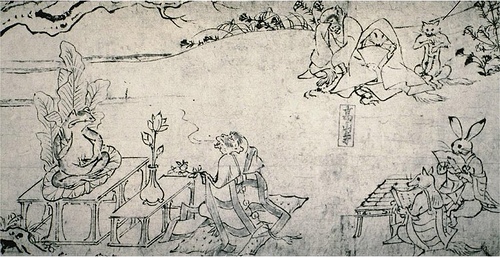
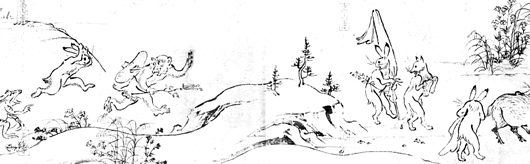
Next we have the Chojugiga. These are anthropomorphic animals depicted at play(or mischief!) in many famous old Japanese paintings.

20130511-123509.jpg

20130511-123522.jpg
Two images from the Chojugiga scrolls. I tried to post the full image of the first, and most famous, scroll, but it was too large for WordPress to handle. Painted around the 12th century, the first scroll(where these images come from) is 36 feet long by 1 foot wide!
Now…on to the pots! For reals!

20130511-012201.jpg

20130511-012219.jpg

20130511-124555.jpg
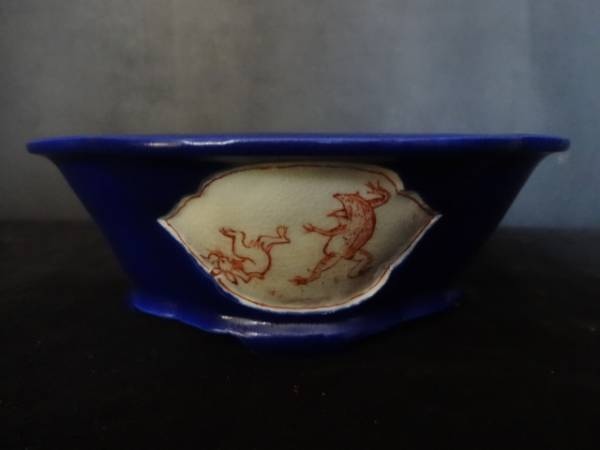
Shunka Seizan window pots, in blue, all showing images from the Chojugiga. While similar in design, these are three different pots. Keep in mind that these are introductory works from a hobby potter…very promising indeed.

20130511-012351.jpg

20130511-012357.jpg
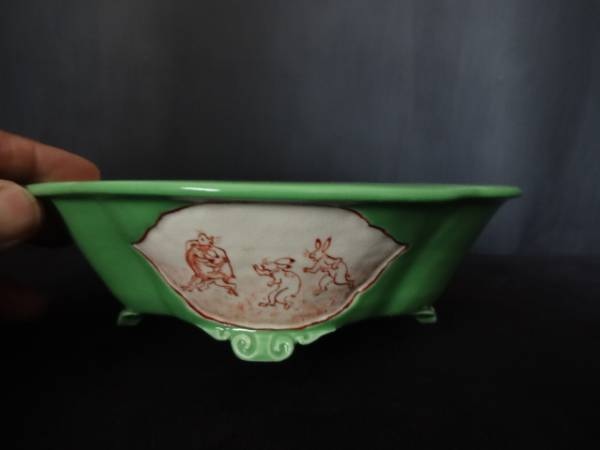
A green and yellow window pot with Chojugiga images. The glaze technique is clean and well done, and the painting very nice, especially from a beginner.

20130511-012602.jpg
A non window painted pot featuring the Chojugiga. Very nice painting on this piece, like it’s peeled from the original sci

20130511-012707.jpg

20130511-012714.jpg
And, images from our other foray into Japanese legend, “Fox’s Wedding.” one a window painted glazed pot, and the other a rectangle porcelain pot. Both are very well executed. If you look back to the earlier post and compare, you’ll note that Shunka Seizan really only makes 3 styles of pots: angular-footed rectangles and squares, and lotus/quince flower shaped pots.

20130511-124452.jpg

20130511-013034.jpg
And we’ll finish up this look at new painted Shunka Seizans with these two dragons pots: one and angular-footed rectangle, the other a quince flower shape. The dragon is well painted and realistic with great expression in both pieces; in fact, it’s better than pots I’ve seen from painters who’ve been doing this for decades…not 6 months to a year!
I think we’ll see great things from Shunka Seizan in the future.

Thanks for reading, I hope you’ve enjoyed a peek at new pots from this promising artist. Up next: Sho Ami, Hikosanjin, and Famous Kutani!

Posted in Modern Potters, Uncategorized | 2 Comments

Heian Kouzan(平安香山)Part 2

My apologies to everyone who received this post earlier today in error. Hit the publish key instead of the draft key! All too easy to do on a phone! Now for the real post!
In Part 1 of our look at the pottery of Heian Kouzan, we looked at glazed and painted pots. In today’s post, Part 2, we’ll take a look at unglazed Heian Kouzan, the pots of Heian Kouzan 2nd Generation, some shohin bonsai in Heian Kouzan pots, and Heian Kouzan artist marks.
Unglazed Heian Kouzan

20130507-124130.jpg
It’s easy to see that this a masterpiece of first generation Kouzan pottery. The burnished clay is lovely, and the pot’s strong lines are softened up considerably by the feet and bottom band.

20130507-124305.jpg
While the photo quality of this selection of views of the pot isn’t great, one can still see the great craftsmanship, and rare, early post-war triple stamp.

20130507-124428.jpg
The unglazed brother to the quartet of glazed Kouo pots in part 1. Clean lines and lovely clay with a great burnished finish.

20130507-124542.jpg
This selection comes from frequent contributor to the site Matt Ouwinga of Kaede Bonsai En. The clay is more rustic than typical Kouzan pots.

20130507-124657.jpg
An unglazed Kouo from my collection. The 6 footed base and hemp rope rim are characteristic Kouzan, used in both early and late work. For an incredible example of earlier work, fired in a climbing kiln, in this style, see Peter Warren’s translated article in the first Bonsai Focus of the year. There’s a great piece in there with a fine oil droplet glaze!

20130507-124814.jpg
Detail of bottom showing the feet and Kouo porcelain signature.

20130507-124902.jpg
A matched pair of Kouo with box and signed cloth. It’s rare to find Kouzan or Kouo with signed box and cloth, rarer still to find a matched pair. The strong bold lines of the pots are typical of Kouo unglazed pots.

20130507-125218.jpg
A brown clay pot with Kouzan’s typical strong lines and cloud feet

20130507-125320.jpg
A semi cascade square Kouzan.

20130507-165127.jpg
A very typical Kouzan with brown clay and cloud feet. Straight lines and clean work from “the Razor Kouzan”.

20130507-165301.jpg
A shallow rectangle in red clay, from my collection. Although it’s signed “Kouzan” I believe it to be from a short while before taking the name “Kouo”.

20130507-165618.jpg
And for our last look at unglazed Kouzan, we have An unglazed rectangle with black landscape. The pot itself, with it’s clean, sharp lines is characteristic of Kouzan’s work, though the black overglaze enamel is a rarity.
Second Generation Heian Kouzan
Second Generation Kouzan are most typically rounds, as Kouzan Jr was a master of the wheel. While his non wheel thrown pots are nice, they don’t approach the quality and fine detail of the father.

20130507-165955.jpg
A trio of Kouzan Jr’s from my collection. The taller cascade is typical of Kouzan Jr work, as are the two different sized Kinyo ovals.

20130507-170131.jpg
A yellow crackle from second Generation Kouzan. A really excellently glazed piece.

20130507-170216.jpg
A very atypical Kouzan Jr. The glaze work is very nice and unique. Note the signature at the upper left: “Shin Kouzan”.
Heian Kouzan Artist Marks

20130507-200510.jpg
The most commonly seen Kouzan marks. The last two were used by both the 1st and 2nd generation, but are much more common on second generation pots.

20130507-200646.jpg

20130507-200656.jpg
These stamped chops are first generation, and and are regarded as early work.

20130507-200834.jpg
This one is a true rarity, and seen on both 1st and second generation Kouzan. The chop is called “Yamaha Sen”, and Kouzan pots with this chop were specially commissioned by Mr. Hatanaka, author of the famous book on bonsai pottery.

20130507-201625.jpg
Early edition nail carved first generation signature.

20130507-201720.jpg
Shin Kouzan, second generation nail carved signature.
Shohin Bonsai in Heian Kouzan Pots

20130507-205426.jpg
A really nice Chicken blood glazed oval holding a very very nice “stinky maple”. The deciduous Japanese Premna is my favorite species of late, they’re unbelievably vigorous and ramify very fast.

20130507-205531.jpg
Umemodoki in a ko-Kinyo oval from Second Generation Kouzan.

20130507-205627.jpg
Kinrobai, or potantilla, and a very nice one at that, in a darker blue glazed Kouzan shallow rectangle.

20130507-205803.jpg
Chirimen Kazura, or dwarf asiatic jasmine, in a robins egg glazed rectangle with cloud feet.

20130507-205916.jpg
Black pine in an unglazed Kouzan rectangle. Most Kouzan are a bit too shallow and not Imposing enough for top of the rack shohin, but this one works well.

20130507-210031.jpg
White pine in an unglazed Kouzan. A really nice pairing.

20130507-210121.jpg
Another Umemodoki, Ilex Serrata, in a light blue first generation Kouzan. I never get tired of Red fruiting varieties in blue pots.

20130507-210239.jpg
Broom Style Zelkova in a blue first generation Kouzan oval. A designated treasure shohin bonsai.

20130507-210333.jpg
Maple in a characteristic Kouzan rectangle.

20130507-210420.jpg
This is something unique! We don’t often see Shinpaku in glazed pots, much less recognized shohin treasures! Somehow, it works, though it’s certainly off putting at first, as nothing more than custom.

20130507-230238.jpg
A raft, or sinuous root, style kaede bonsai in a deeper blue glazed Kouzan. Often, artists will leave the glaze off the feet to show off the clay. In this case, the clay compliments the trunk color, a very nice detail.

20130507-230343.jpg
And last, I stepped outside this afternoon and snapped a quick pic of one of my shohin Zelkova brooms, in a yellow second generation Heian Kouzan pot. Here in the deep deep south, early November is still early fall, before the leaves change. This was one of the trees I was planning to use for a shohin display submission for Artisans Cup. A few days in the fridge and Bam! Red and yellow fall colors days before the show. Would’ve looked great with the yellow Kouzan pot. Already looking forward to 2015!

Thanks for reading this second part of the pottery of Heian Kouzan. I hope you’ve enjoyed it. Up next, painted pots from Shunka Shozan, the whimsical minis of Heian Sho-ami, and antique Chinese pots!

Posted in Famous and Antique Potters, My Personal Collection | 3 Comments

Retrospective

20130504-235400.jpg
It’s been 2 years since I started this website, in May 2011, and I’m very happy to report that it’s become the go to English resource worldwide for information, edification, and identification of Bonsai pottery. This month marks another milestone for the site, 200,000 views, so I thought it would be fitting To take a look back at some of my, and your, favorite pots and other images we’ve looked at on the blog.
You can access the table of contents through the menu bar at the top of the page, and have a look back yourself if you like, I think I’ve put up a good amount of information over the last two years: I hope it’s as interesting to you as it is to me!
Now, on the montage!

20130504-235721.jpg

20130504-235729.jpg

20130504-235736.jpg
Three of my favorite Heian Tofukuji we’ve looked at on the blog. The first is mine, and I hope you can see how much my photography skills have progressed! The latter are excellent examples of kiln change glazes: unpredictable Noborigama(climbing kiln) glazes that produce some insanely unpredictable and lovely results(in the hands of a master!).

20130504-235830.jpg
A trio of painted pots from an old collection post: Haruyoshi, Teizan, Seiwafu.
20130504-235931.jpg
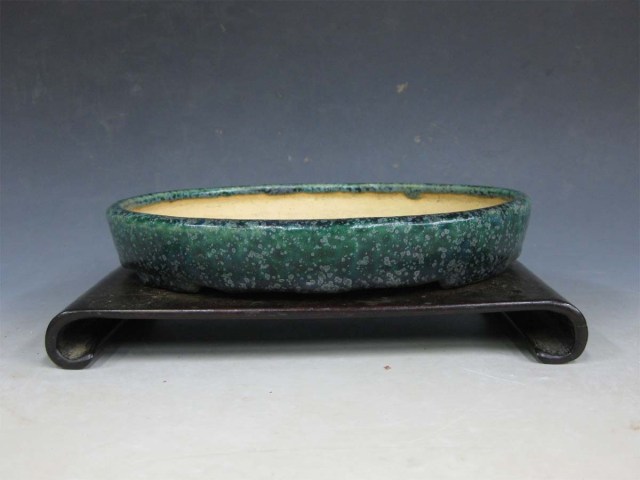
A rare oval Ino Shukuho from the post dedicated to him.

20130505-000015.jpg
Miyazaki Isseki from the Isseki post.
20130505-000057.jpg

20130505-000104.jpg
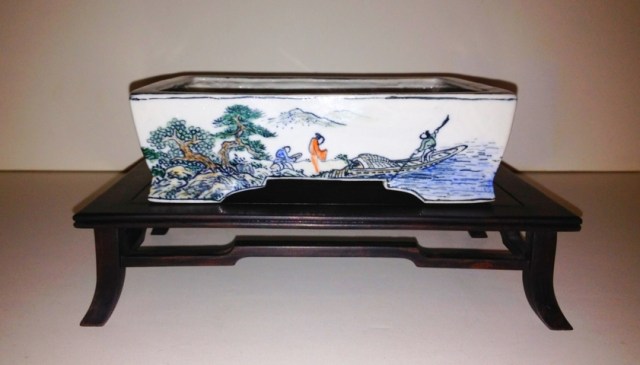
A couple of Echizen Hosui painted pots. I thought his work was undervalued 2 years ago, and I still do.
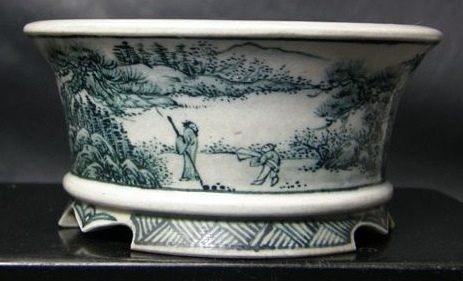
20130505-000135.jpg
Sano Daisuke collaboration with Konno Shinzan.

20130505-000216.jpg
Okatani Zeshin, the Timothy Leary of Japanese Potters.

20130505-000250.jpg
A precious and rare terebineri pot by Ueda Naokata, from “A Very Special Pot”.
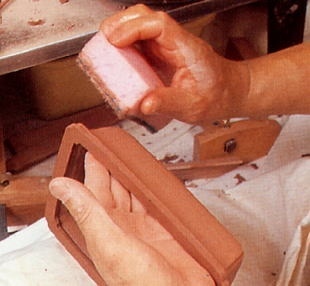
20130505-000400.jpg
The hands of Kamiya Ryuen at work, from “Pots and Process.”

20130505-000445.jpg
A Sanshu Ichiyo with incredible patina!

20130505-000540.jpg
Shunka Shozan, one of my favorite contemporary potters. He just began painting pots in the last year, and a post will be forthcoming, his painted pots feature the anthropomorphized animals of the Chojugiga, and are awesome!
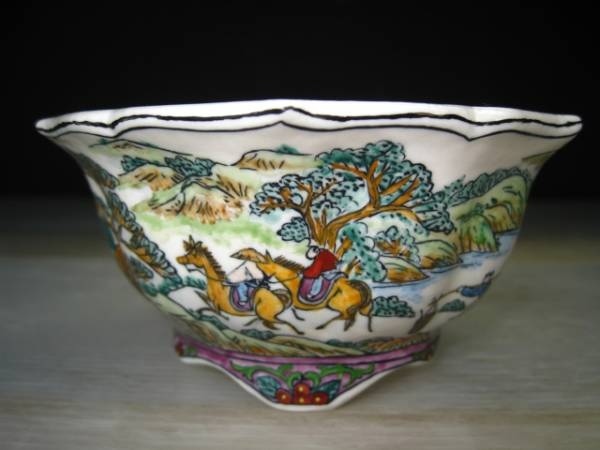
20130505-000740.jpg
Kyogoku Shiho

20130505-000818.jpg
Uematsu Tosui, “1st generation”, from the post “Demystifying Tosui”.

20130505-000926.jpg
Yuraku, the Yusen homage king.

20130505-001009.jpg

20130505-001017.jpg
Gyozan, Yukizou and Yuuji, respectively: the top of the top shelf Tokoname.

20130505-001103.jpg
Takao Koyo

20130505-001136.jpg

20130505-001141.jpg
A pot by Haruyoshi with a killer winter landscape in overglaze enamel and dyed porcelain, followed by a view of the recent pieces fresh from the kiln! If you’ve haven’t already, like him on Facebook: he not only makes and paints gorgeous pots, but produces awesome mame and shohin bonsai, which he posts often.

20130505-001313.jpg
A marvelously glazed Shigeru Zyubei, a gift from my buddy Matt Ouwinga of Kaede Bonsai En, when I turned 35 last year. If only all my friends gave me killer pots for big birthdays!

20130505-001507.jpg
A little display with a new years scroll for guest Brian Van Fleet when he visited my garden around New Years. The scroll is pine, bamboo, and Ume, classical new year’s symbols of good luck, long life, and strength in Japan.
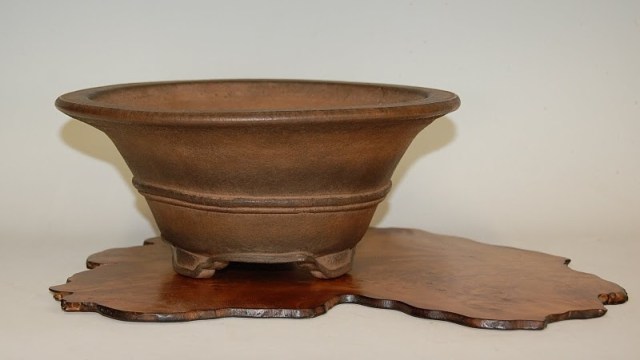
20130505-001810.jpg
Suzuki Syuzan: THE Japanese master of unglazed pots.

20130505-001857.jpg
Tsukinowa Shousen, grandson of Yusen, and one of the most masterful painters of the modern era.
20130505-002125.jpg
A shohin YamaMomiji from the collection of Bill Valavanis, in the “Bonsai Gardens of the Northeast” posts. A very special tree, originally grown by the founder of shohin bonsai, and chairman of the first Kokufu Ten, Count Matsudaira. A post on the history of shohin bonsai, which is directly linked to the availability of small Japanese bonsai pots, is in the works!
20130505-002523.jpg
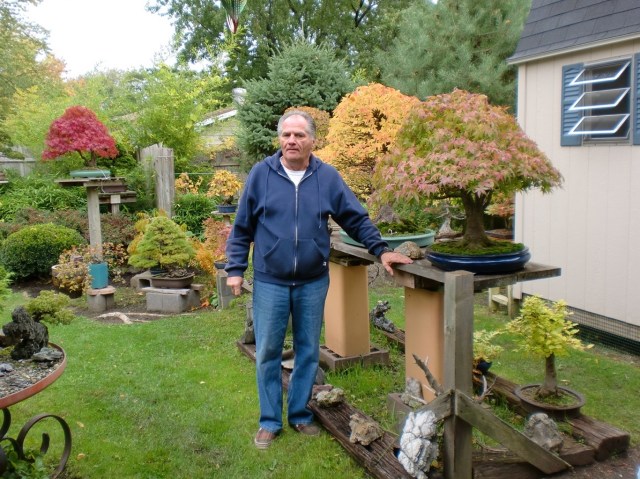
Harvey Carapella with some of his wonderful trees showing their Autumn colors. From the “Bonsai Gardens of the Northeast” posts.

20130505-002716.jpg
The view from the entrance to Doug Paul’s Kennett Collection. I can’t say enough about how impressive it is. Probably the best bonsai collection outside of Japan, and it certainly would rank there, as well. Over a thousand top shelf trees in a beautifully landscaped setting in the middle of nowhere in Pennsylvania. Absolutely inspirational.
20130505-003057.jpg
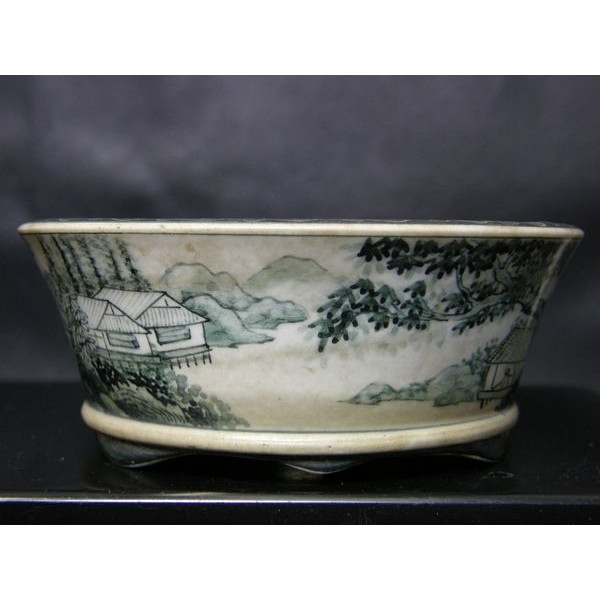
A rare black and white painted pot by Ito Gekko.

20130505-003136.jpg
Heian Kouso, whose mentor(possibly father)was close friends with Tofukuji, Kouzan, Yusen…many of the most famous potters of the 20th century met and discussed pottery at Kouso-En, when Heian Kouso was but a boy. But he remembered, and were it not for his work, most of them would have remained in obscurity after their deaths.
20130505-003524.jpg
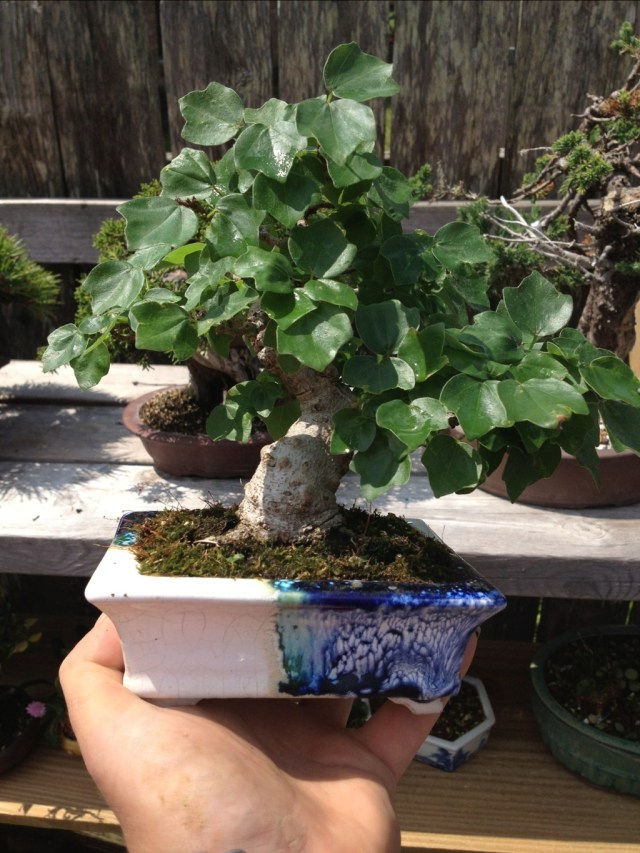
My shohin Miyasama Kaede, in a Bushuan pot. Harvey Carapella used this image to create my surprise logo, which appears at the top of the page. It’s classical yet modern, old school but still cool, just like Harvey. I love his work and the logos he created for me.

20130505-004438.jpg

20130505-004446.jpg
Before and after Shimpaku rough stock, styled in a full day where I worked with Bjorn Bjorholm one on one, last year.

20130505-004628.jpg
I have a lot of Bravermans, some Hagedorns, some supa early edition Rayners when production levels were low, pretty much something from everybody and a good selection of rare stuff…but this pot by Peter Krebs is my favorite western pot in my collection. I’ve seen a whole bunch of carving and motif pots, and Peter’s are every bit as good, if not better, than anything Ive seen from the East. Now, if we could get ourselves a painter….
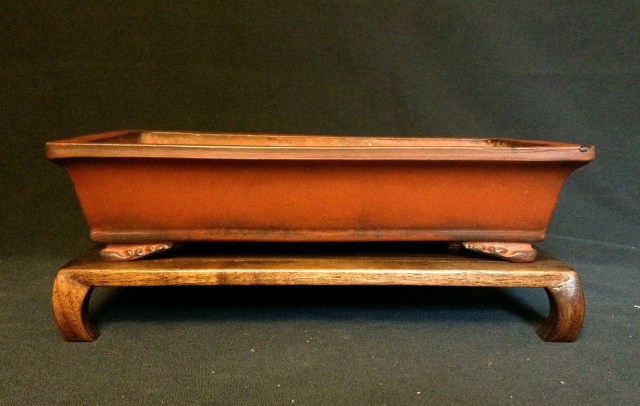
20130505-004931.jpg
A lovely stamped Middle Crossing Antique Chinese from my collection. Untinted clay like this simply doesn’t exist anymore.
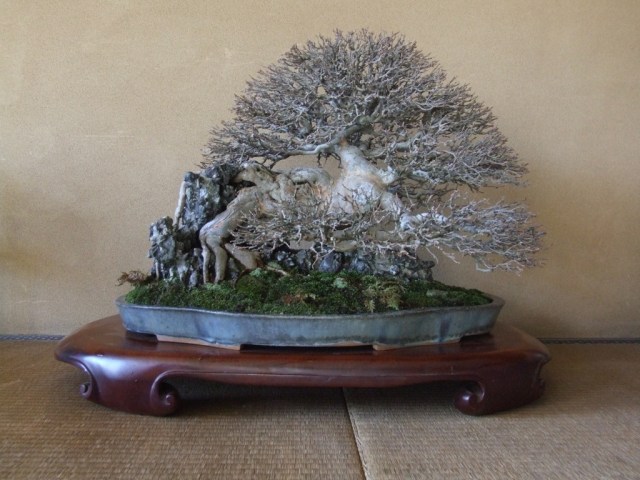
20130505-005611.jpg
Root over Rock owned by friend Matt Ouwinga of Kaede Bonsai En. A real lesson in ramification, shown in Kokufu this year. More American enthusiasts should do so…I’m saving as we speak!

20130505-005817.jpg
A page from the Bonsai Sekai articles penned by my Japanese friends, about our tour of “Bonsai Gardens of the Northeast.” Look close and you can see me with Suthin, his wife Donna, and Endo. Don’t miss Suthin’s collection if you have the chance, it’s one of the best on the right coast.

20130505-010111.jpg
A really cool ShiShimaru pot with its own stand. Check put the post, a lot of work went into finding more out about that shady, yet talented, character.

20130505-010231.jpg
A shohin Shimpaku in my garden this spring.

20130505-010348.jpg
A carved Sruga Yamasyo from the post dedicated to his work. I got a lot of emails about him and sourcing them, beware!, the nice ones are expensive(but totally worth it!).

20130505-010539.jpg
A collaborative pot from Seifu Yohei and Tsukinwa Yusen, from the collection of frequent contributor Matt Ouwinga.

20130505-010717.jpg
A really wonderful Fujikake Yuzan, painted inside, out, and bottom, from “An Interesing Yuzan”.

20130505-010848.jpg
Third generation Inoue Ryusei.

20130505-010923.jpg
A really nice Ogurayama, carved and painted, from the collection of Neil Dellinger. A really unique and characteristic piece of Ogurayama work, and For Sale(it’s on the page) to boot! I’m a little surprised no one has grabbed it yet!
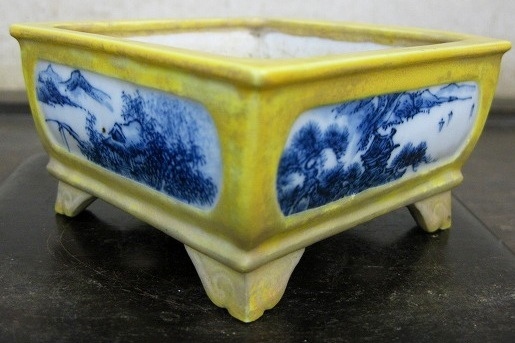
20130505-011142.jpg
The rarest of the rare: yellow glazed window painted pot by Tsukinowa Yusen.

20130505-013739.jpg
A Yusen featured in the post dedicated to his work, published in “Charisma”.

20130505-013839.jpg
The “after”. From “Semi Cascade Black Pine and Bjorn”.
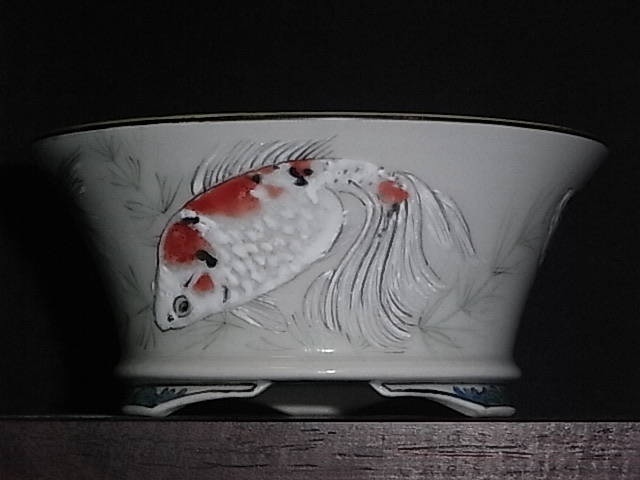
20130505-013936.jpg
A really wonderful overglaze enamel porcelain pot from Kutani Ikko. Simply three dimensional.

20130505-014031.jpg

20130505-014038.jpg

20130505-014055.jpg

20130505-014110.jpg
And. Of Course. Last but not least, and all that. Perhaps no potter has stirred more response from you, my readers, and no “perhaps” about it; no potter has stirred more response from me, than Shigeru Fukuda, Bushuan Kiln. The above 4 are/were part of my collection, as is the pot that my logo tree is in. His glazes are both bold and classical, easy to use yet outlandish. I make no bones about my taste for his work, and find it unsurprising that no one in Japan can describe him without mentioning Tofukuji.

I hope you’ve enjoyed this walk down memory lane. Thanks to all who read, and more thanks to all who encourage others to read. There’s still a serious lack of information about Bonsai pottery in the west, I’ll continue to rectify that in any way I can. Many more posts are in the works, so stay tuned!

Posted in Uncategorized | 5 Comments